
On the first day of spring, a solemn ceremony for the national film awards "Big Kristaps" will take place at the Riga Congress House. The nominees for the film award were announced the day before.
Having studied the lists of nominated films, the Minister of Culture Agnese Lāce discovered: Latvian cinema is experiencing a kind of Renaissance!
The Transitional and Disappearing Prize
"Big Kristaps" was established in the Soviet year of 1977 as an annual award ceremony for the best film. At that time, it was an innovation, as the list of nominees resembled the American Oscars – best film, best director, screenwriter, lead and supporting actors, composer, make-up artist, etc.
Initially, it was a transitional award, with the first recipient being the film "The Boy" by Aivars Freimanis in 1977. The award was given every two years, and in 1979, the prize went to the immortal film "Theatre" by Jānis Streičs. Since 1998, the prize has remained permanently with the winners.
At first, this prize was a wooden sculpture of the mythical Latvian hero Kristaps (a mythological ferryman across the Daugava, guardian and protector). Three such samples are kept in the Museum of Cinema and the Union of Filmmakers.
Over the years, laureates began to receive small bronze figurines of Kristaps. By the way, five years ago, a curious incident occurred – one bronze prize for a foreign participant of a Latvian film lay on the table during a noisy buffet, and while a colleague of the absent winner was giving an interview, the award... disappeared. It was never found.
Flying Over 'Swallow's Nest'
The event became a full-fledged film festival in 1989, showcasing dozens of feature, documentary, and animated films of the year. Since 2001, the festival has been held every two years, and since 2014 – annually, organized by the Union of Latvian Filmmakers.
Since 1998, an award has been given in the category "For Lifetime Contribution to Cinema." Its first recipient was the outstanding artist Eduards Pāvuls – the unforgettable Ozols from the series "A Long Road in the Dunes."
By the way, the winner in this category is announced in advance, and it is already known that this year the award will go to actor and stuntman Uldis Jānis Veispāls. Over half a century in cinema, he has participated in the creation of hundreds of film and television projects in Latvia and abroad, becoming one of the founders of professional stunt work in Latvia and the Baltic States, as well as contributing to the formation of the stunt profession and the implementation of safety standards.
One of his most famous stunts is a head-first jump from the cliff of "Swallow's Nest" in Crimea – from a height of about 40 meters into the sea.
For Others into Fire and Water
One of the films that almost everyone knows is the aforementioned "A Long Road in the Dunes," where Uldis Jānis doubled for Eduards Pāvuls's character walking through a burning house. He also voiced Christopher Lee in the film "Mio, My Mio," and together with English actor Sean Bean, he filmed and directed the historical battle drama "Under the Brave Command of Sharpe."
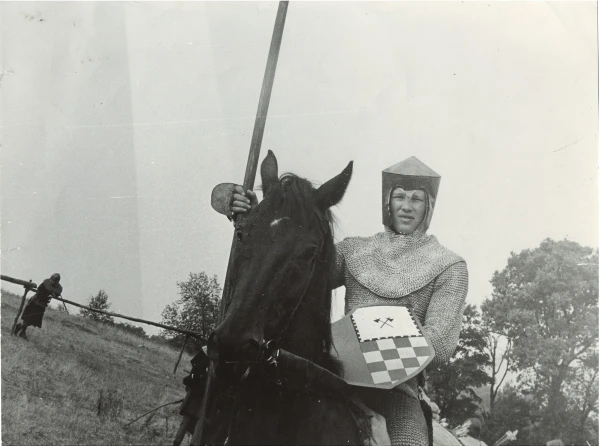
His very first experience in cinema was participating in the 1975 film "The Arrows of Robin Hood," where Veispāls replaced the lead actor Boris Khmelnitsky in stunt scenes of knightly duels.
Alongside his work in cinema, Uldis Jānis Veispāls worked for forty years in the field of sports and education, passing on knowledge to the younger generation in a sports academy, as well as participating in the creation of theatrical and opera productions as a movement consultant and engaging in business.
Describing his attitude towards the profession, Uldis Jānis Veispāls emphasizes: "Being a stuntman is not about fearlessness, but about precise calculation, discipline, and responsibility for the health and life of a person. Every stunt is a team effort, the goal of which is not to show off, but to create believable and safe cinema. Professionalism means knowing not only what can be done but also what should not be done."
In 1979, he also started in Russian cinema, participating in battle scenes of the film by the Moscow Gorky Film Studio "The Squadron of the Flying Hussars."
The Life and Adventures of Alice von Trott
This year, the feature film "Lotus" directed by Signe Birka has the most nominations (a total of sixteen!).
According to the plot, in 1919, Alice von Trott returns to her father's estate in Latvia to sell it and start a new life. She faces hostile resistance from local workers and finds herself caught in a carefully planned trap created by a demonic lawyer, a decadent underground organization, and its necrophiliac leader! Already cool!
Escaping from the clutches of her "assistants," she meets several silent film enthusiasts and learns to use cinema as a means of healing and self-discovery, as a weapon against enemies.
In second place (thirteen nominations) is the film "In the Net. The Birth of the TTT Legend" by Dzintars Dreiberga, which the portal bb.lv recently wrote.
Announce the Full List
This year, 85 films were submitted for the "Big Kristaps" competition:
- 6 feature films,
- 5 miniseries,
- 11 co-produced films,
- 14 short feature films,
- 11 feature documentaries,
- 8 short documentaries,
- 3 animated films (including 1 feature-length),
- as well as 27 student works.














Leave a comment