
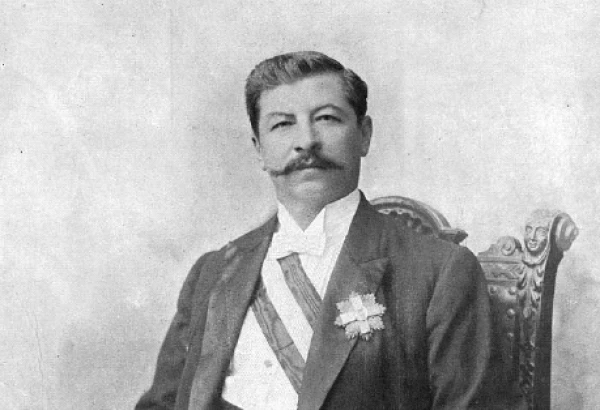
Gómez's rule was characterized by frequent changes to the country's fundamental law — during his time, 7 constitutions were adopted.
In connection with the events in a major Latin American country, interest in its history has naturally awakened. Here, Juan Vicente Gómez (July 24, 1857, La Mulera, Táchira, Venezuela — December 17, 1935, Maracay, Aragua, Venezuela) is particularly interesting — a Venezuelan military and political figure, president, and dictator of Venezuela (1908–1935).
Youth
Gómez was born into a well-known family of Andean landowners living in La Mulera. He had virtually no formal education and was a cattle herder in his youth. By descent, he was almost a pure-blooded Indian. When Gómez turned twenty-five, his father died, and he became the head of the family.
Three years later, he joined the private army of Cipriano Castro, with whom he had long been friends. Castro appointed him colonel of the autonomous army of Táchira. In 1892, former president Joaquín Crespo, taking advantage of a constitutional crisis, raised an armed rebellion that was supposed to be suppressed by Cipriano Castro but was defeated. Gómez and Castro were forced into exile in Colombia until 1899. In that year, as a result of a successful uprising against President Ignacio Andrade Troconis, they first occupied Táchira and then Caracas. Gómez was appointed governor of the federal district.
In 1901, a new constitution was adopted (from the time of gaining independence in 1831 to 1945, Venezuela had a total of 22 versions of the constitution) — and Gómez, along with General Ramón Ayala, became vice presidents. In December 1902, he led government troops to suppress a rebellion by some military and landowners; after defeating them, he earned the nickname "Peacemaker." The military triumph made him so popular that President Castro began to suspect his associate of wanting to take his place. In 1906, Castro announced his resignation as president to test Gómez's reaction, but he did not fall for the provocation.
In 1908, the president went to Europe for treatment, and this time he had a real opportunity to organize a coup, which he took advantage of. He did not allow Castro to return to Venezuela, forcing him to remain in exile.
At the Helm of Venezuela
When Gómez came to power, many believed that the era of dictatorships had ended, and the "Peacemaker" Gómez would grant citizens significant freedoms. Initially, this perception was confirmed: the new head of state freed political prisoners and called on those who had been forced to leave the country during Castro's rule to return home. Freedom of the press was restored, and the presidential term was reduced to four years. Gómez's rule was characterized by frequent changes to the country's fundamental law — during his time, 7 constitutions were adopted (in 1909, 1914, 1922, 1925, 1928, 1929, and 1931).
In 1910, he became president. While in power, he sought to create a democratic facade for his authoritarian rule; however, time and again amendments were made to the Constitution that expanded his personal powers. Formally leaving the position of head of state, he remained the Supreme Commander, stripping his successor of these powers through the National Congress; upon returning to the presidency, he again combined these positions. In 1922, the term of the head of state was extended "for Gómez" from four to seven years.
In 1914, he declared himself a constitutional dictator and subsequently legislatively confirmed his position with a decree in 1922 and the adoption of a new constitution in 1925. In 1929, he was re-elected but refused to take the presidential post, preferring to govern the country as the supreme commander. In 1931, he became president again.
Domestic Policy In implementing domestic policy, a course was taken to strengthen the centralization of the state, form a vertical power structure, overcome separatist sentiments among regional elites and leaders, introduce a system of direct control over tax collection, reform the armed forces, and create a regular army. At the same time, the president appointed personally loyal people, mainly compatriots from Táchira, to key positions. They concentrated financial flows, including from the exploitation of the country's natural resources, primarily oil.
Over time, he began to harshly suppress not only rebellions but also to repress those who merely criticized him on specific issues. Under the noble slogan: "Union, Peace, and Work," courts ruthlessly sent such individuals to prisons or sentenced them to road work. The estates of landowners who fell out of favor were confiscated, and property was seized. Even Gómez's own brother, suspected of having political ambitions, was physically eliminated in 1923.
As a result, the old regional opposition elite was defeated or expelled from the country, and the new one could not take shape for a long time. Unexpected unrest for the dictator occurred only in 1928. In February, anti-government student demonstrations began in Caracas, receiving support from the capital's population. The Gómez regime had not experienced such upheavals before. In response to the barracks situation, all military personnel, including cadets from the Military School and even the honor guard, were transferred. Army patrols supported police actions against the demonstrators. Soon, the riots were suppressed. However, in April, the situation worsened even further. A group of military personnel rose against Gómez, and a rebellion began in the San Carlos barracks. Government-loyal troops were put on combat alert. The commander of Caracas, General López Contreras, personally entered the barracks and ordered the arrest of the rebels. His appearance was unexpected, and none of the conspirators had time to resist.
Becoming even more suspicious, the president personally approved the candidacies of parliament deputies. Courts were under strict control. The government council had exclusively representative functions; notably, there was also a Public Chamber. After a series of rebellions, he banned all political movements, including the Communist Party, founded in 1931.
A distinctive feature of Gómez's rule was that he regularly seemed to withdraw from affairs and went to the city of Maracay, located near the capital. In the presidential residence "Miraflores," nominal figures remained who performed protocol functions in his absence, received foreign ambassadors, participated in meetings, etc.
The ideological basis of the regime was formed by the theory of "democratic caesarism," or the "necessary gendarme," created by sociologist Laureano Valenilla Lanz. Its key element was the thesis of the reluctance to self-governance in the traditions of certain peoples (including Venezuelans). From this flowed the necessity for a strong ruler — a "Caesar," whose task was to combine the best attributes of democracy and autocracy in governance. The rule of the Caesar was positioned as the only way to overcome anarchy in society and establish the peace and order necessary for social progress.
The second key postulate of democratic caesarism was the thesis that the Anglo-Saxon model of democracy, alien to its nature, could not take root in Venezuelan soil. The country should choose a special path, taking into account its historical peculiarities.
In his later years, his aura as the "father of the nation" and "strong leader" acquired ominous sacred traits for the population. He stopped appearing in public, constantly staying in Maracay, and no one saw him except for relatives and close confidants. Citizens were merely "given down" decisions that they had to follow unconditionally.
Economy In the economic sphere, it was during his rule that the extraction, industrial processing, and export of hydrocarbon raw materials began, bringing good dividends. Taking into account the experience of Mexico, which had faced great difficulties in a similar situation, he turned to representatives of foreign oil companies with a proposal to present options for joint development of oil fields, in order to choose the most profitable one. After consultations with experts, he managed to conclude agreements that guaranteed the interests of Venezuela and allowed it to fulfill all its financial obligations. By the end of his rule, Venezuela had become the only country in the world with no debts, and the country ranked second in the world in oil production. At the same time, critics of the dictator claimed that he had enriched himself by $30 million solely from bribes for granting concessions. The dictator was also criticized for the fact that the relationships established between his regime and foreign monopolies clearly infringed upon Venezuela's interests. In the absence of any legal restrictions for foreigners, the state's share of revenues from the exploitation of its own natural wealth was very small, allowing some companies to earn up to 100% profit annually.
Social Policy
In the social sphere, Gómez's dictatorship, despite economic growth, did not lead to any positive changes. The living and cultural standards of the majority of citizens remained extremely low; by the end of his rule, 70% of children and adolescents were illiterate, and only 11% attended educational institutions.
Despite the obvious positive economic results of his rule, Venezuelans had a negative attitude toward the dictator, and Gómez's death in 1935 caused widespread rejoicing. Venezuelans destroyed several government buildings, editorial offices of official newspapers, and the homes of Gómez's closest associates. Clashes occurred in the capital between rampaging crowds and the police.
Image in Literature
Vicente Gómez became one of the prototypes of the main character in Gabriel García Márquez's novel "The Autumn of the Patriarch." Gómez is also a character in the novel by Venezuelan writer Arturo Uslar Pietri "The Funeral Mass." Allegorically, the times of dictatorship are depicted in the tale by Venezuelan Antonio Arraiza "Uncle Jaguar and Uncle Rabbit."





Leave a comment