
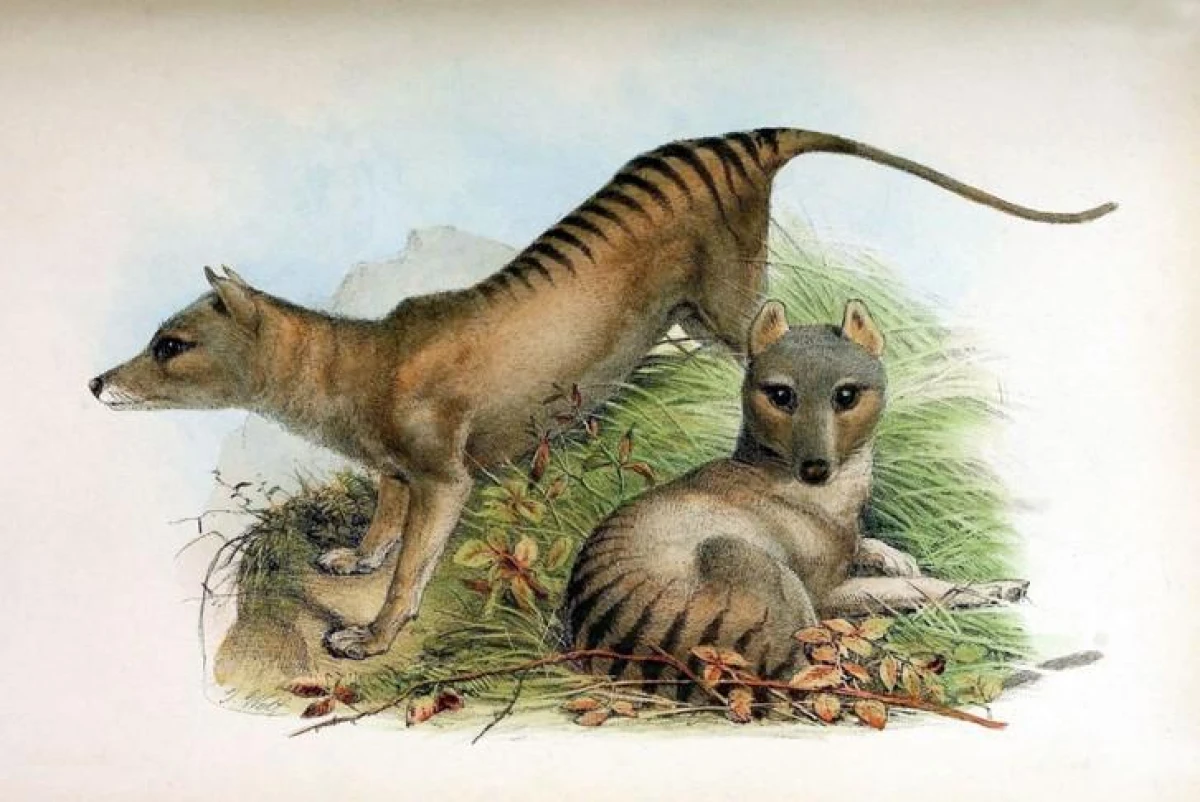
The thylacine, or Tasmanian tiger, was the only marsupial predator on Earth. This animal inhabited Australia and nearby islands, but its population sharply declined with the arrival of Europeans, and the last representative of the species died in 1936.
Australian geneticists intend to resurrect the extinct predator using genetic engineering technologies, reports Washington Post.
For millions of years, the Green Continent was isolated, which contributed to the formation of a unique environment and the emergence of the first primitive mammals, such as platypuses and marsupials.
The arriving colonizers not only actively hunted but also brought agriculture and domestic animals with them. These factors led to the rapid disappearance of some species of fauna.
For instance, the flat-tailed parrot and several species of bandicoots went extinct. The thylacine lasted longer but eventually remained only in old footage of newsreels.
Externally, the predator resembled a dog, reaching a length of 1.3 meters, not including its half-meter tail. It had straight black stripes on its back, which is why the thylacine was also called the Tasmanian tiger.
This predator retained unique features of the evolution of prehistoric marsupials. It could open its mouth at a 90-degree angle, and the abdominal pouch was present not only in females but also in males, who hid their reproductive organs in it. In the black-and-white footage of newsreels, it is evident that the animal's behavior significantly differed from modern ones.
The thylacine was the largest predator in Australia, New Guinea, and Tasmania until humans and their pets led to a decline in its population. The last representative of the species died in a zoo on Tasmania in 1936.
Recently, biologists from the University of Melbourne, who dream of seeing the ancient predator, received a grant of $5 million for research. Professor Andrew Pask and his colleagues aim to “turn science fiction into reality.” Their motivation is not only curiosity but also the desire to preserve endangered species.
The revival of the thylacine is planned using cellular material from its closest living relative — the narrow-footed marsupial mouse. Scientists will then need to create a thylacine embryo and place it in the body of a large marsupial, such as a spotted-tailed quoll. The procedure will need to be repeated many times to create a population capable of living in the wild. This is not the first attempt to restore the species.












Leave a comment