
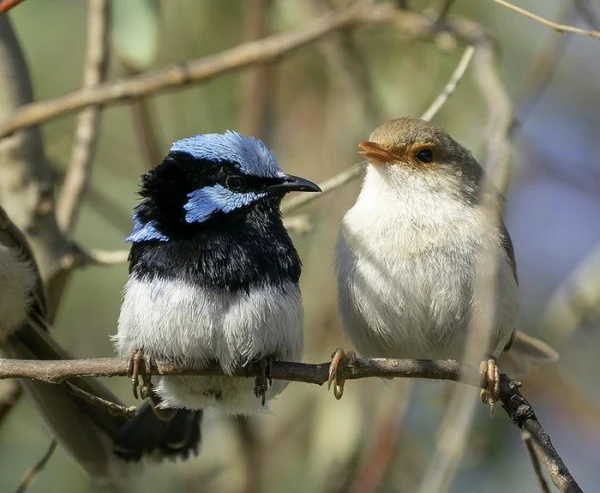
Birds are the first to announce the arrival of spring, filling the morning hours with their trills, accompanying us on our way to work and lulling us in the evenings. But what do they sing about? It is not just the joy of the warmth coming.
It is no secret that most animals communicate primarily through smell. However, birds are an exception: they use acoustic and visual signaling. Whistles, chirps, tweets, trills, and even imitation of human speech—all these sounds have their unique meanings.
Reasons for Bird Song
Vocalization in birds is a combination of innate and learned characteristics. The innate part includes the basic elements of song that are genetically passed down from generation to generation, forming the vocal foundation of each species. However, feathered creatures learn to sing from an early age: as chicks, they listen to the songs of their parents and other adult members of their species, and then they copy and refine the sounds they hear.
There is an opinion that vocalization is intended solely for attracting mates. Indeed, most singing birds are males, who use their songs to attract females, “pouring” their courtship into their ears and signaling their readiness to breed. The more beautiful and complex the song, the higher the likelihood of attracting the attention of a potential partner. However, birds compose their songs not only for this purpose.
Vocalization can also serve as a means of protection. With their songs, feathered creatures create noise that can disorient a predator or cause it to flee. If a predator approaches too closely, they begin to sing louder and faster to attract the attention of their kin and create the impression of a large flock.
Some bird species use their vocal abilities as a means of camouflage: they can imitate the sounds of other animals or even other birds to conceal their presence.
How Birds Sing
Sound production in birds occurs through the lower larynx, which contains a special organ—the syrinx. It is similar to the human larynx, but unlike it, it branches into two tubes and resembles an inverted letter Y.
Air passing through the vibrating membranes and cartilages at the junction of these tubes generates sounds. Birds can regulate the airflow in each half of the syrinx separately, allowing them to produce two sounds simultaneously. Some species, such as the wood thrush, are capable of singing using both ascending and descending notes.
Birds sing without pauses for inhalation thanks to a unique respiratory system: in addition to separate channels of the syrinx, they have two air sacs that work in conjunction with the lungs to provide a constant airflow. During singing, air enters one sac and exits through the other, allowing the bird to sing without interrupting its breathing cycle. Many artists could envy this feature!
It is important to note that the ability to sing varies among different bird species. Some, such as canaries or nightingales, are known for their beautiful voices and complex melodies. At the same time, crows or pigeons have less melodic voices. This is because each bird has a unique set of vocal organs that determine the sounds they can produce.
Thus, one can identify a bird by its song. However, some songs are so similar that even the birds themselves sometimes cannot distinguish their species from another. But this is more of an exception than a rule. To identify a bird by its melody, one can study audio recordings of various species' voices online or in specialized audiobooks, as well as use applications based on artificial intelligence.
Interesting Facts About Bird Song
Bird vocalization can be used to determine age and sex: in some species, males have more developed vocal cords, allowing them to produce loud and complex sounds.
Many species of songbirds have dialects characteristic of specific regions.
The melodiousness of bird song depends on the structure of their beak: insectivorous birds with thin and delicate beaks can produce incredibly complex songs, while birds with more massive beaks cannot perform melodies with rapid sound alternation.
Birdsong has inspired many famous composers, such as the Frenchman Maurice Ravel, who wrote the famous suite “Le chant d'oiseau” (“The Song of the Bird”) for piano four hands. The work consists of four parts: “Prelude,” “Chorus of Birds,” “Meditation,” and “Sonatina.”















Leave a comment