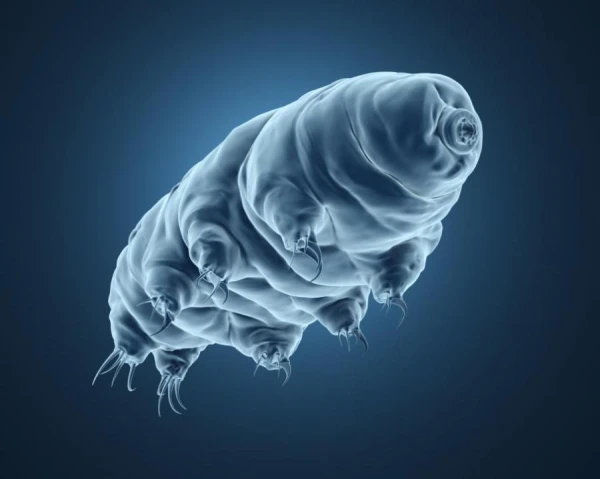
Scientific research confirms that it is tardigrades.
The first to study this microscopic invertebrate, measuring from 0.1 to 1.2 mm, was the Italian zoologist Lazaro Spallanzani in the 1770s. He named it "tardigrade," which in Italian is il tardigrado, and in Latin zoology it became established as Tardigrada. Tardigrades cannot exist without moisture: they inhabit freshwater bodies, damp soil, as well as permeable mosses and lichens, on tree trunks and in rocky mountains.
When moisture is insufficient, tardigrades enter a state of anabiosis, which can be described as a false death. This may seem surprising, but even after 100 years, desiccated tardigrades can be "awakened" with a drop of water. Overall, among all living beings, tardigrades are unmatched in endurance under extreme conditions.
According to research, tardigrades in a state of anabiosis can withstand cooling down to -271 °C for several hours, survive brief heating up to 150 °C, and endure significant radiation exposure and high pressure.
Japanese scientists conducted an experiment in which "sleeping" tardigrades were placed in a sealed container and submerged in a high-pressure chamber filled with water, with the pressure gradually increased to 600 MPa (which is nearly 6 times the pressure at the lowest point of the Mariana Trench). As a result, most of the test tardigrades successfully coped with this incredible challenge, which would be insurmountable for other living beings.