
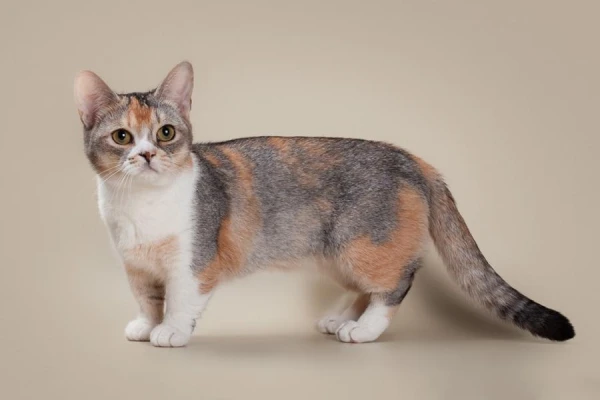
Although these cats cannot jump onto the refrigerator in one leap, their resourcefulness and intelligence will help them find the shortest path to their goal.
There are about ten breeds of short-legged cats in the world, among which the most well-known are the Munchkin and Bambino.
Munchkin
This breed became the foundation for all other short-legged cats. The official history of Munchkins began in 1983 when music teacher Sandra Hockenedel from Louisiana found a pregnant cat with a unique mutation — short legs. The future mother was named BlackBerry.
In the first litter, most of the kittens inherited the short-legged gene. One of them, a kitten named Toulouse, was given by Sandra to her friend Kay Lafrance. It was BlackBerry and her son Toulouse who became the founders of two genealogical lines from which Munchkins descended.
The breed's name comes from the miniature inhabitants of the fairy-tale city of Munchkin — characters from the book “The Wonderful Wizard of Oz” by American author L. Frank Baum. In the Russian version written by Alexander Volkov, these good-natured little ones were called chewers, as the word “munch” translates to “chew.”
Munchkins were first introduced to the public in 1991 at a regional cat show. The reaction was mixed: despite their attractive appearance, the new breed was perceived as carriers of a non-viable mutation. However, years of observation and genetic studies showed that short legs are merely an anatomical feature that, unless it takes extreme forms, does not harm the health of the animals.
In 2004, the International Cat Association (TICA) officially recognized Munchkins as a breed. Modern Munchkins come in two varieties — long-haired and short-haired.
These cats are energetic, cheerful, and very sociable. Munchkin owners can be sure that their curious pet will leave no corner of the apartment unattended. Due to their small stature, they can quickly move under sofas and other furniture without stopping or bending down.
If something particularly interests the short-legged explorers, they sit on their haunches in a gopher-like position and study the object of their attention for a long time.
Bambino
The first kittens of this breed appeared by chance. In the early 2000s, spouses Pat and Stephanie Osborn from Arkansas acquired a hairless kitten with unusually short legs.
After studying the kitten's pedigree, the Osborns learned that its parents were a Canadian Sphynx and a Munchkin. The amusing little one charmed the couple so much that they decided to breed such cats in their cattery. Pat, of Italian descent, named the breed “bambino,” which means “child” in his native language. This name stuck, and rightly so: in terms of temperament, Bambinos remain children even in adulthood.
In 2005, simultaneously with the Americans, breeding such cats also began in Russia. The Russian progenitor of the breed was the Baby Moon cattery, founded by Elena Chernova.
Crossbreeding Munchkins with the hairless Canadian Sphynx did not lead to additional problems. Moreover, compared to other short-legged cats, breeders find it easier to notice “problem areas” in hairless cats, such as X-shaped limbs or a crooked sternum, which may indicate health issues.
Like Munchkins, Bambino cats are very sociable and curious. The lack of a natural hunting instinct allows them to coexist easily with other pets, even rodents and birds.
However, short-legged cats do not tolerate loneliness. Therefore, owners should think ahead about purchasing a carrier — they will likely have to travel together.








Leave a comment