
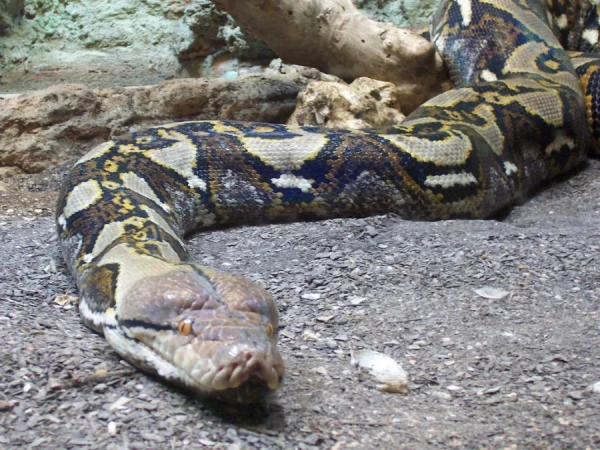
An international group of researchers from the UK, Australia, South Africa, and Vietnam studied the growth rate of reticulated and Burmese pythons, as well as their food consumption during active growth. The results showed that these reptiles gain weight quickly in their first year of life while consuming minimal feed. The scientists concluded that breeding these snakes for meat could be an effective way to ensure food security.
The study involved scientists from Macquarie University and the University of Adelaide in Australia, as well as researchers from the University of Oxford in the UK, the University of the Witwatersrand in South Africa, and the Institute of Tropical Biology of the Vietnam Academy of Science and Technology.
In the abstract of their study, the authors noted that the depletion of natural resources and increasing climate instability negatively impact agriculture, necessitating the search for alternative food sources.
“Breeding pythons has already proven successful in Asia, yet it has not attracted the attention of leading agronomists. We measured the growth rates of two species of large pythons (Malayopython reticulatus and Python bivittatus) on farms in Thailand and Vietnam, as well as conducted feeding experiments to assess their production efficiency,” the researchers commented.
The scientists hypothesized that breeding these species of pythons could be profitable for farmers, as they are large reptiles. Adult individuals can weigh over 100 kg, and females are very prolific. They reach sexual maturity by three years and can lay up to 100 eggs annually for over 20 years.
The study showed that pythons gained weight rapidly in their first year of life: reticulated pythons gained 19 grams per day, while Burmese pythons gained 42 grams.
Furthermore, when the reptiles were deprived of food (in the experiment – for up to 4 months), they lost on average only 0.004% of their body mass per day and began to grow quickly again as soon as they were given access to food.
“The ability of pythons to regulate metabolic processes and maintain their condition under starvation conditions enhances food security in unstable environments, suggesting that breeding pythons could be a flexible and effective solution to the global food shortage problem,” the researchers emphasized.
The scientists found that after processing a python, 82% of its body mass is suitable for consumption. In this regard, pythons proved to be the most economically viable for breeding among all agricultural animals.
The results of the study were published in the journal Scientific Reports.












Leave a comment