
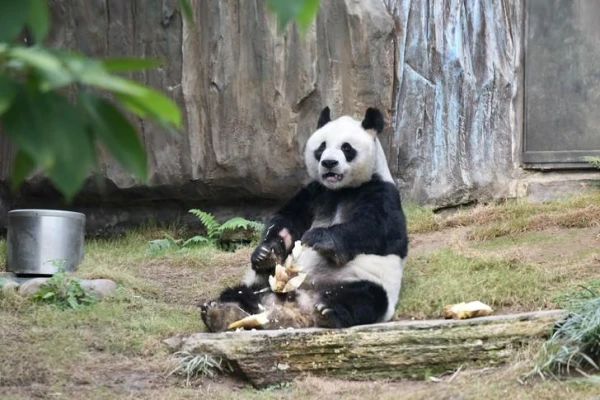
It is almost impossible to find a person who does not admire pandas! These charming creatures stand out not only for their unusual coloring but also for their way of life. Unlike other bears, pandas do not eat berries, fish, or bark, but feed exclusively on bamboo! Unfortunately, their uniqueness has led to serious problems...
In July 2021, the head of the Department of Nature Conservation and Ecology of the Ministry of Ecology and Environment of China announced that pandas are no longer on the brink of extinction; however, the black-and-white bears still remain in a vulnerable position.
The main reason for their precarious situation is the loss of their natural habitat. Humans have destroyed a significant portion of the bamboo forests that are vital for these animals. Since pandas feed exclusively on bamboo, they cannot adapt to life outside these forests. Previously, wild pandas inhabited the bamboo forests of China, Vietnam, Laos, and Burma. Currently, wild individuals are found only in China, and scientists estimate that there are only about 1,800 wild pandas left in the world.
Another reason for the vulnerability of pandas is their low adaptability. Many animals whose natural ranges have been 'captured' by humans have managed to adapt to new conditions. For example, raccoons, which used to live primarily in forests, now inhabit many cities and towns around the world! However, raccoons did not simply 'wish' to adapt — their physiological traits, such as their digestive system and compact size, helped them in this.
Pandas, on the other hand, find it extremely difficult to do so. Firstly, they are quite large, and secondly, their diet consists exclusively of bamboo, and their digestive system is unable to process other foods. Additionally, pandas have difficulty crossing cities to move from one forest to another. Since bamboo shoots and leaves contain few nutrients, pandas must consume them in large quantities (10–20 kg per day). When crossing through cities, the animals would have to face hunger.
There is another reason why scientists are concerned about panda populations. Even in captivity, breeding these animals is a complex and lengthy process. These bears are extremely selective in choosing a mate, which means that even if a male and female panda are in the same enclosure for many years, there is no guarantee that they will want to breed. However, if a panda in a sanctuary gives birth, the staff must care for the offspring, as it seems that life in captivity 'erases' the maternal instincts of females. Because of this, specialists cannot return pandas to the wild, as they are completely unprepared for independent life.
Undoubtedly, like many other endangered species, pandas suffer from poachers. The fur of these bears has a high value on the black market. In China, where pandas live in the wild, there are strict penalties for those caught poaching these animals. Unfortunately, this does not deter hunters...











Leave a comment