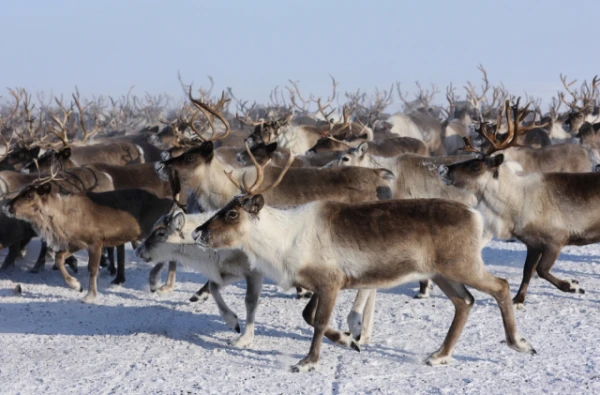
Deer exhibit unusual instinctive behavior—they can form "whirlwinds," running in circles for several hours.
The first to study this phenomenon in detail was scientist A. Golovneva, who captured mesmerizing footage of a circle of deer during an expedition to the Kola Peninsula in 2018. Later, he published a scientific article explaining why deer behave this way.
For herd animals, forming circles is a kind of social signal. They mimic each other's behavior during this time. Individuals begin to walk in a circle when they sense danger, are in a state of stress, or are waiting for a decision from their leader. In this way, the animals calm down.
Moreover, according to zoologists, this behavior misleads predators by creating a significant barrier in front of them, preventing them from capturing fawns or weakened individuals. In the summer, by rotating, deer also protect themselves from pesky horseflies and gnats.
Circling is characteristic of both wild and domesticated individuals. Even in enclosures, deer feel anxious and form circles. By studying these behaviors, people have begun to apply them when necessary to calm a herd, concentrate it in a specific area, or capture certain individuals for harnessing.