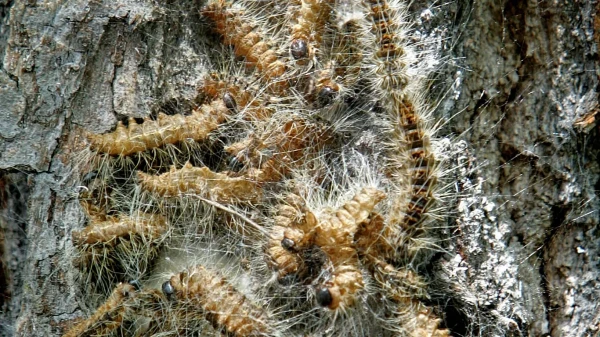
Even without the usual sensory organs, caterpillars can navigate dangerous environments — and they do so in a rather unusual way. Research has shown that the hearing of butterfly larvae is not linked to ears, but to the fine hairs covering their bodies.
The reason for the experiments was an unexpected observation: caterpillars jumped at sudden sounds, as if reacting to fear. To understand what exactly they perceive — surface vibrations or sound in the air — biologists conducted a series of experiments in the anechoic chamber of Binghamton University. There, they eliminated external reflections and were able to accurately separate vibrations from sound waves.
It turned out that for caterpillars, sound carries more information, although they also detect mechanical vibrations. However, the larvae do not have ears in the conventional sense. Their role is performed by sensitive hairs on the thorax and abdomen, which respond to air vibrations.
To test this hypothesis, researchers removed some of the hairs from the test caterpillars. After this procedure, the reaction to sound noticeably weakened: the larvae became less capable of distinguishing acoustic signals.
Scientists suggest that this auditory system evolved as a defense against predators, particularly wasps that hunt caterpillars and produce sounds in the range of 100–200 hertz. By detecting these frequencies with their hairs, the larvae recognize the approach of danger and try to hide.