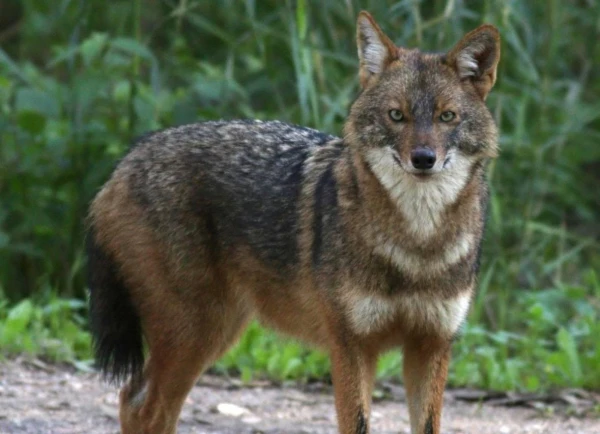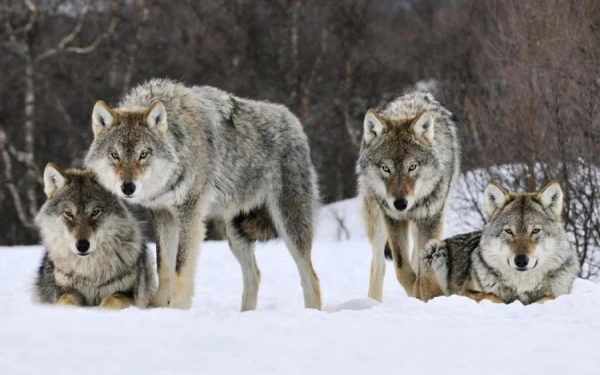
The wolf population in Italy currently stands at 3,000–3,500 individuals; in the early 1970s, they were nearly extinct in the country.
In early January, a video shot on a residential street in the northern Italian city of Pesaro quickly spread online. Filmed from inside a car, it shows a wolf running just a few meters away; behind it, the lights of a bar are visible, and then it turns onto a side road and disappears.
In recent weeks, dozens of similar incidents have been recorded in urban areas of the Romagna region, including the cities of Rimini and Cesena.
Social media is filled with clips: wolves strolling past houses; one even captured three wolves on the street devouring a cat.
These increasingly common sightings have sparked a discussion about the return of wildlife and the problems it brings to people. It is a question of coexistence that has intensified in other European countries, including France, Germany, and Spain. In Latvia, rural residents are suffering from wolf attacks on pets and livestock.
A Pack of Wolves Forced the Italian Airport to Suspend Operations
On January 6, the regional airport Rimini Fellini halted all departures and arrivals. The reason was not the winter weather that affected other European hubs, but a pack of four wolves spotted near the runway.
Fortunately, only one flight was affected: the airport operates on a reduced schedule in winter. But the more important question is why the animals were there in the first place.
Pier Claudio Arrigoni, a wildlife and hunting expert in the Rimini area, told local media that the wolves, which have been living here for two years, were likely attracted to the airport by rabbits: the snow has driven them from their usual hunting grounds.
Residents Created a 'Wolf Emergency' Committee
Concerned citizens are asking the same question, and a special 'wolf hotline' is operating in Rimini to handle inquiries.
According to biologist Tania Bascucci, who works at this hotline, wolves are attracted to cities by garbage bags, trash containers, and even dog food in gardens.
She stated that attacks on people are rare and only occur when wolves become overly accustomed to human presence and lose their natural fear.
However, they do attack dogs, sheep, goats, and other livestock because they are easy prey.
"We advise keeping animals sheltered in a closed pen at night," she told local media. "A traditional 'anti-wolf' pen should be bent at about a 45-degree angle so that the animal cannot climb over it."
But such recommendations do not satisfy everyone.
In Rimini, residents have created a 'wolf emergency' committee, pointing to the growing wolf population as a key issue.
Currently, the wolf population in Italy is estimated at 3,000–3,500 individuals; in the early 1970s, they were on the brink of extinction in the country.
"We have to choose whether to give our territory to wolves or to people; there will be no coexistence," they stated in a candid declaration.
"We know little about wolves because they have not been here for at least 100 years. Back then, farmers had shotguns, and there were 'wolf hunters' who were paid to eliminate them."
Dissatisfaction has arisen from authorities' recommendations to keep pets indoors at night or to build safer pens outside.
"Now we are being convinced that the problem lies with us. We will be forced to erect fences two to three meters high, underground barriers, electric fences, and barbed wire (often prohibited), and keep dogs and cats locked up," the statement continued.
"But in the village, dogs serve as guards, not companions; cats are kept to scare away mice and rats."
'The Presence of Wolves is Beneficial'
Despite the increased sightings and attacks on animals, conservation organizations emphasize the benefits of the return of wolves.
The Rimini branch of WWF stated that the presence of wolves represents "a valuable resource."
"This restores balance in the ecosystem and limits the population of wild boars, which has sharply increased," the organization added.
Wolves in the Crosshairs: EU Governments Agree to Simplify Hunting and Trapping
However, local authorities believe that this approach diverges from broader European sentiments. Last year, the European Parliament downgraded the wolf's protection status in the EU from 'strictly protected' to 'protected.'
This means that member states now have more flexibility in managing wolf populations to improve coexistence with humans and minimize the impact of the growing wolf population in the EU.
They will also find it easier to take measures tailored to specific regional conditions.
Authorities in Emilia-Romagna note that the national management plan, which regions are required to follow, has not changed since 2002 and does not reflect the downgrade of the wolf's status as a protected species at the European level.