The international team of scientists had to delve into the bamboo thickets.
An international team of scientists has announced the discovery of a new species of poisonous frog of the genus Ranitomeya in the Alto Purús National Park, located in the Peruvian Amazon.
The scientific discovery highlights the value of protected natural areas as refuges for unique biodiversity.
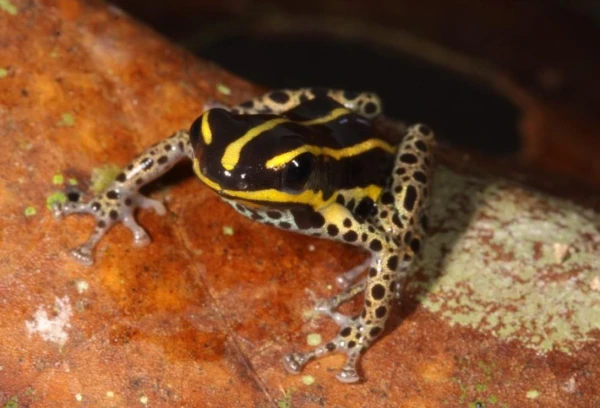
The discovery was published in the scientific journal Zootaxa and disseminated by the National Service of Protected Natural Areas (Sernanp), an agency under the Ministry of the Environment of Peru. The species, named Ranitomeya hwata, reaches only 15 millimeters in length, making it one of the smallest representatives of its genus.
The frog is distinguished by bright yellow stripes on its back, a spotted pattern on its belly, and a characteristic black stripe separating the throat from the abdomen. Like other poisonous frogs, this coloration serves as a warning to predators.
This amphibian inhabits exclusively in bamboo forests of the genus Guadua, using the natural cavities of these plants as breeding sites.
Unlike related species, male Ranitomeya hwata exhibit a polygynous behavior: they attract several females to one location for breeding, which is a unique feature of their reproductive strategy.
The research was conducted by specialists from Germany, Brazil, the USA, and Spain, along with leading Peruvian scientists, including Giuseppe Gagliardi-Urrutia (IIAP), Juan C. Chaparro (Museum of Biodiversity of Peru), and Roberto Gutiérrez Poblete, a researcher from the Natural History Museum of the National University of San Agustin in Arequipa and an expert at Sernanp.
The discovery of Ranitomeya hwata expands knowledge of the diversity of Amazonian amphibians and underscores the importance of conserving ecosystems such as the Alto Purús National Park, which serves as a refuge for unique species still unknown to science.