
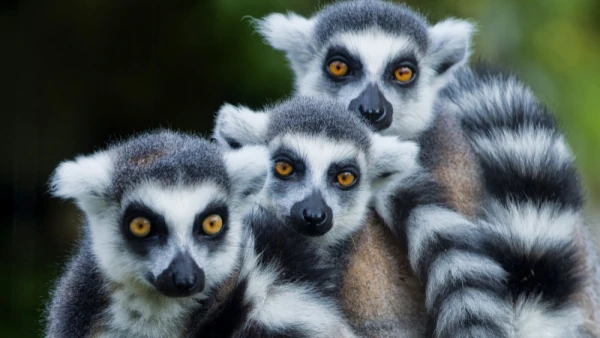
Scientists from Duke University (USA) are conducting an unusual study not in engineering laboratories, but at the Lemur Center. They are trying to unravel the secret of hibernation — so that in the future, people could, like in science fiction films, fall into a long sleep during interstellar travel.
The idea is not new — we encounter it in the fairy tale "Sleeping Beauty" and the movie "Alien." But in reality, freezing people in cryogenic chambers would lead to serious health problems, including memory and cognitive loss. Scientists are looking for another way — "warm hibernation," and they are being assisted by dwarf fat-tailed lemurs from Madagascar.
"The opportunity to study hibernation in our closest relatives is an incredible stroke of luck," notes Ana Brait, a researcher at the Lemur Center.
Until 2004, science did not know that primates were capable of hibernation at all. It turned out that fat-tailed lemurs can spend up to seven months a year in a state of torpor. During this time, their metabolism slows down, body temperature nearly matches the ambient temperature, and heart rate and breathing become barely noticeable.
The Duke Lemur Center is the only place in the world where a colony of these unique primates is kept under human observation. They have created special chambers where they can simulate the climate and light cycles of Madagascar. Each lemur has a radio collar that tracks skin temperature, and special equipment measures metabolism.
Why is this important for space exploration? Hibernation would solve several critical problems of long space flights: food and water supplies would be significantly reduced, less oxygen would be required, muscle and bone degradation would be prevented, and issues of boredom and loneliness during months-long flights would disappear.
Brait and her colleagues received a $30,000 grant to study the features of hibernation at different temperatures. The scientists are comparing two groups of lemurs: one group is kept in a room with a constant temperature of 18–22 °C, while the other is in conditions where the temperature fluctuates from 12 to 32 °C, as in nature.
"Lemurs in a stable environment must actively warm themselves, expending more energy," explains Brait. "Those in fluctuating temperature conditions can passively warm themselves each day, conserving precious fat reserves."
Particular attention is paid to cognitive functions. Dr. Brendan Johnson, a veterinarian and researcher, conducts memory and problem-solving tests with the lemurs — giving them puzzles for which they receive half a raisin as a reward.
"The main question is: will astronauts be able to operate a spacecraft after waking up?" says the scientist.
The same tests are repeated after hibernation to assess any possible changes. Simultaneously, researchers are studying how hibernation affects immunity and inflammatory responses — it is important to understand whether lemurs (and in the future, humans) can get sick during anabiotic states.
To ensure that laboratory data aligns with reality, Brait's team also conducts field research in Madagascar. There, graduate student Antonin Andriamahayhavana observes wild lemurs in their natural habitat.












Leave a comment