
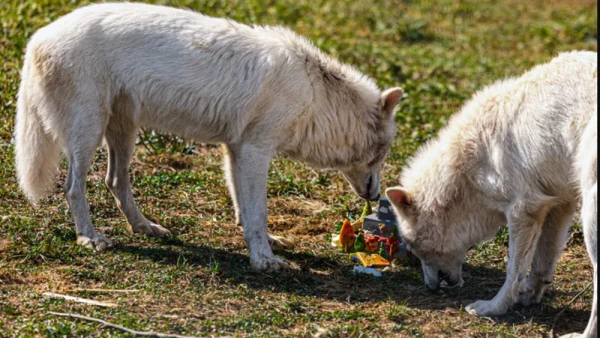
Geneticists created them based on the DNA of an extinct animal.
A year ago, on October 1, 2024, Colossal Biosciences successfully revived an extinct species of animal for the first time in the world. This concerns the dire wolves Romulus and Remus, who recently celebrated their first birthday. Three months after them, their younger sister—a female wolf named Khaleesi—was born.
Now the grown pups are doing wonderfully. Each weighs over 54 kilograms and consumes more than 2.3 kg of meat daily—venison, beef, and even whole rabbits. Their diet also includes bones and freeze-dried liver, which is used during training. It is expected that the wolves will continue to grow for another two years, with Romulus already surpassing his brother in development and soon potentially reaching 63 kilograms.
The unique animals live in a spacious ecological reserve covering 2,000 acres, certified by the American Society for the Prevention of Cruelty to Animals. Their health and behavior are monitored around the clock by veterinarians, specialized staff, as well as drones and surveillance cameras.
To celebrate the wolves' first birthday, Colossal organized a real party. Famous musicians—Emmy winners Stan Bush and Lenny Macaluso—were invited, who wrote a special rock anthem in the style of the 80s titled "Happy Birthday Dire Wolf," according to People.
"A year has passed, and you are still alive. I will sing you this song. Live forever, with strength and will to live," the lyrics say. — "You have returned—two wild, majestic brothers. Ancient blood flows in your veins."
There was also a festive cake. It was created by a dog bakery from San Francisco. It took 15 hours to make the three-tiered masterpiece in a natural style. The cake, made of beef pâté, broth, liver, and other organic ingredients, was decorated with mountains, trees, the moon, and wolf figurines. Romulus and Remus eagerly tore apart and ate their unusual gift.
The company's chief scientist, Beth Shapiro, noted: "The dire wolves are thriving—we could never have imagined this was possible. The most important thing is that the genetic modifications worked as expected, and the animals are healthy. This is evident from their size, strength, and bright white fur."
In parallel with the work on the dire wolves, the company has made significant progress in reviving another extinct bird—the dodo. Recently, scientists managed to cultivate primordial germ cells, which is an important step towards restoring this species. According to experts, the first dodo birds may appear in the world in five to seven years.











Leave a comment