
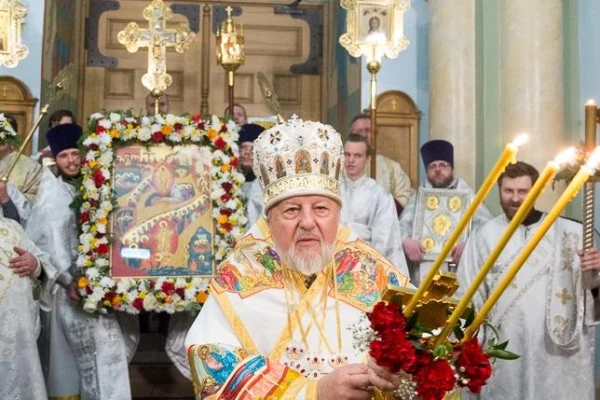
The Easter service is the most important event of the year. Believers gather in the church shortly before midnight.
How Does the Easter Service Proceed?
On Saturday evening, usually an hour or half an hour before midnight, a pre-festive midnight office is held in churches. The main part of this ritual involves the priest reading the canon of Great Saturday, which recounts the burial of Christ. During the midnight office, there is also a procession around the shroud — a large cloth depicting the icon of the Savior in the tomb. At the end of the reading, the shroud is taken to the altar and placed on the holy Table.
After the midnight office, the procession begins, followed by the Easter morning service at midnight. As noted by the Orthodox magazine “Foma,” in some churches, the Easter morning service starts exactly at midnight, and the procession begins 15 minutes before that, while in others, the procession starts at midnight.
In Orthodox tradition, dark shades do not correspond to the joy of Easter.
The procession goes around the church and is accompanied by a special Easter bell ringing. This process involves clergy and parishioners singing: “Your Resurrection, O Christ Savior, the angels sing in heaven, and grant us on earth to glorify You with a pure heart.”
After the procession is completed, the procession stops at the closed western gates of the church, symbolizing the doors of the Lord's tomb. The bells fall silent, and the priest proclaims the joyful news first: “Christ is risen from the dead, trampling down death by death, and granting life to those in the tomb.” The clergy and parishioners repeat this song three times, after which the priest sings the lines of the prophecy of King David: “Let God arise, and let His enemies be scattered...”. The people respond to each verse: “Christ is risen from the dead...”. Then the doors open, the worshippers enter the church, and the Easter morning service begins — the singing of the canon of Saint John of Damascus.
The morning service concludes with the words: “Let us embrace one another, saying: brethren! and forgive all by the Resurrection.” After this, all present in the church, first the clergy in the altar, then the parishioners, begin to greet each other — kissing three times and greeting each other with the joyful words “Christ is risen!” — “Indeed, He is risen!”.
After the greeting in the church, the Paschal homily of Saint John Chrysostom is read, which reveals the spiritual essence of the holiday. Then several hymns are sung, and the Divine Liturgy begins, during which the Gospel is read in various languages: Old Church Slavonic, Russian, Greek, and others. At the end of the service, after the communion of the parishioners, the artos is blessed — a special bread with the image of the Cross or the Resurrection of Christ, which will be cut and distributed to the people a week later, on Saturday.
And only after this do the believers leave the church, heading to the refectory or home to begin the feast.
When Exactly Does Easter Occur?
According to the Orthodox portal “Azbuka Very,” the boundary between Holy Week and Easter falls on the Saturday before the procession.
The publication “Pravmir” reports that just before midnight, “the solemn ringing announces the arrival of the great moment of the Light-bearing Feast of the Resurrection of Christ.” At this moment, a quiet singing begins in the altar, which gradually intensifies, and from the height of the bell tower, a jubilant Easter ringing sounds, under which the believers perform the procession.












Leave a comment