Traditions and high quality of products.
The ceramics of the British factory Wedgwood have been regarded as a standard of quality for over two and a half centuries. Its finest examples—porcelain and earthenware with elegant shapes, thin walls, and strict patterns—are recognized as true works of art. These items adorn the collections of museums, including the Hermitage and Peterhof, and evoke pride among wealthy collectors.
Throughout history, many royal families of Europe and other high-ranking individuals have commissioned Wedgwood tableware. Among the famous connoisseurs is Russian Empress Catherine II, who ordered 952 dining items featuring images of England from the factory.
What makes Wedgwood porcelain so famous?
The history of Wedgwood porcelain began in 1759 when the hereditary English potter Josiah Wedgwood established his factory. By this time, he had already accumulated significant experience, having started working in his older brother's workshop at the age of nine.
In his childhood, Wedgwood contracted smallpox, which later led to the amputation of his leg. The master found it difficult to work at the potter's wheel, and perhaps this is why he focused on inventing tableware and developing new painting technologies. Studying literature on ceramics and conducting his own experiments allowed him to create new clay compositions, as well as methods for coloring and firing it.
In the 1750s, Wedgwood began collaborating with Thomas Whieldon, an outstanding English potter of the time. Soon he introduced one of his main inventions—a refined creamware covered with the thinnest glaze. This tableware received the title of “royal”: English Queen Charlotte, appreciating the beauty of the products, became the master's patron.
Having founded a village with the exotic name Etruria for England and placed his factory there, Wedgwood continued his experiments and created a unique ceramic material called “black basalt” based on Egyptian clay. From it, vases, candlesticks, and various decorative items resembling ancient bronze began to be produced.
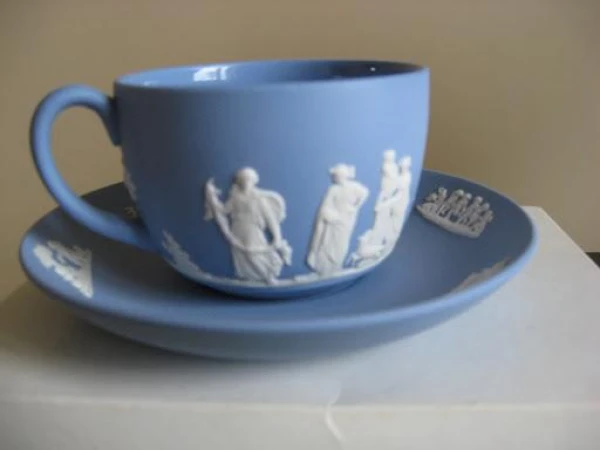
During this period, perhaps Wedgwood's most significant creation was jasperware, which combined transparency and “airiness” with remarkable strength. Jasperware was most often colored in pale blue, light green, lilac, and black, and it was adorned with white patterns and reliefs in the classical style. The most famous item made of jasperware became a copy of the 1st-century “Portland Vase,” found during excavations in Italy.
Wedgwood porcelain gained lasting popularity and continues to be held in great respect today. The master's craft is passed down from generation to generation. Today, the Wedgwood company produces a variety of tableware for discerning clients, constantly emphasizing its traditional quality.