
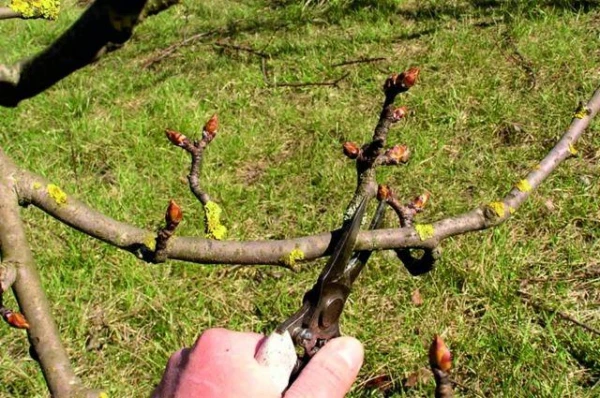
To form the crown of young apple trees, the most developed and lush branch is chosen. It should be stronger and taller than the others. Two other branches are left so that the angle of their divergence is at least 90 degrees.
If the central leader is weakened, bent, or damaged, and a competing branch is stronger, the leader is removed, leaving the competitor. In cases where one of the branches is weak, a temporary replacement is left next to it, shortening it. The following year, the best of them is chosen, and the worst is cut back to the ring. Severely bent seedlings need to be tied to a stake. If there is no leader, the upper branch replaces it, which is vertically tied to a stake.
Constant attention should be paid to the proper direction of the branches. Vertical shoots are pruned to the outer buds to promote crown expansion. Inner buds directed upwards are pruned only on severely inclined branches, which occurs quite rarely.
If you have one-year-old seedlings without branching, they should be shortened to a height of 80-85 cm, selecting the upper, well-developed, and undamaged bud so that the shoot from it grows almost vertically. Shoots that appear in the trunk area should be removed. The height of the seedling's trunk on seed rootstock is 60 cm. The formation of the crown is carried out according to the principle described above.
When pruning after planting, it is not advisable to shorten the ends of all branches, which many amateur gardeners often do.
For the next 3-4 years, pruning should be minimal. The main goal is to adjust the crown and obtain the maximum number of growing shoots.







Leave a comment