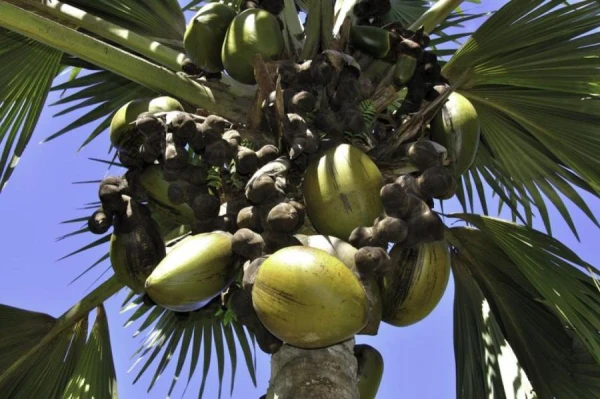
On a unique palm.
Since ancient times, people have found enormous nuts washed ashore by the currents of the Indian Ocean, which resemble a heart cut in half with a narrow constriction. As no one knew where they grew or where they came from, these unusual fruits were long attributed with mythical origins and magical properties.
When the 'sea nut' reached Europe in the 16th century, it immediately gained immense popularity — monarchs and aristocrats, eager to acquire them as talismans and protective amulets, were willing to pay exorbitant sums for them. For one such 'heart', which can reach up to 50 cm in diameter, one could obtain an entire ship loaded with goods.
Only in 1742 did French explorers clarify the situation with the mysterious nut. While studying the Seychelles archipelago, they found a palm tree on one of the islands that produces these amazing fruits. The Seychelles palm (Lodoicea maldivica) — the only species of the genus Lodoicea in the palm family — reaches a height of up to 30 m and a diameter of about 30 cm, at the top of which are up to 30 large fan-shaped leaves.
This slow-growing tree forms male and female inflorescences 1–2 m long, with flowering lasting 8–10 years. Inside the large fruit, which matures in 7 to 10 years and weighs up to 16 kg, is the largest seed in the plant kingdom, forming over a period of about one and a half years.