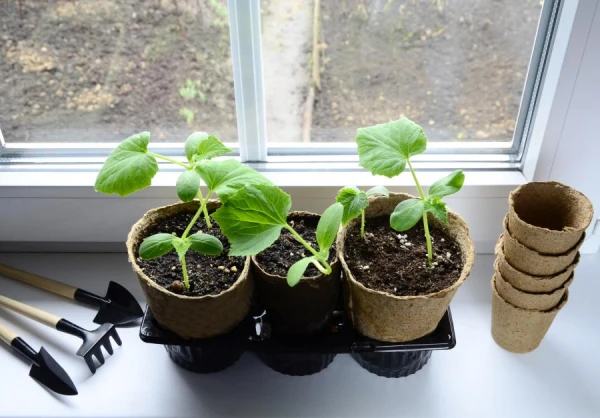
At the end of the winter period, the sowing of seeds for crops that yield early harvests or require prolonged germination begins. Agronomist Nadezhda Lebedeva explains which plants are suitable for this and how to create optimal conditions for them.
Onions
Some varieties of bulb onions are recommended to be sown in winter to obtain an early harvest. It is advisable to sow them in February.
These onion varieties are sown in the ground in the second decade of the month. The sprouts appear quite slowly, and the weak shoots may look frail. However, over a couple of months, while they are in the container, the seedlings become strong enough.
The crop is cold-resistant, so it can be transplanted to the garden bed when the nighttime temperature reaches about +10°C. At the same time, the shoots can withstand slight frosts, provided they are not prolonged.
Eggplants
Eggplants are also sown in February — usually in the third decade of the month. There is no need to rush: if the seeds are sown earlier, the sprouts will be too elongated and weakened.
First, the eggplant seeds are soaked, and then placed in the soil a few at a time. Weakened sprouts should be removed immediately. The seedlings are moved to the greenhouse no later than mid-May, otherwise the plants may become overgrown.
Celery
This aromatic plant can be either annual or perennial. At the initial stage, celery grows quite slowly, so experienced agronomists advise planting it in February.
The initial growing period is about 2 months, and it takes approximately 3 weeks for the first sprouts to appear. For more uniform and faster germination, celery seeds are placed in hot water to remove the essential oils that hinder germination. It is also beneficial to treat the seeds with a growth stimulant.
When planting in containers, two seeds should be placed at once. After germination, one of the sprouts — the weaker-looking one — must be removed.
Strawberries
At the end of winter, you can start growing strawberries. In just a couple of months, the seedlings will develop into strong bushes, and by late spring or early summer, they can be transplanted to the garden beds.
Strawberries germinate quite slowly, with the first sprouts appearing in 3-4 weeks. Therefore, the sooner you can sow them, the better.
This crop requires special care, particularly high lighting requirements. Therefore, it is recommended to install special LED lighting and ensure that the lighting period lasts 12-14 hours.