
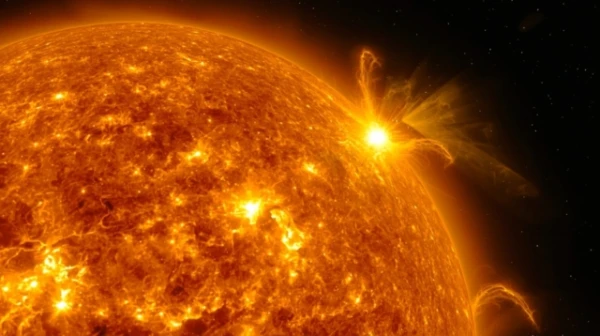
The first disturbances caused by the February surge of solar activity have begun to reach Earth. However, their impact remains limited for now, so any potential magnetic storms, if they occur, will be of low intensity. This was reported by specialists from the Solar Astronomy Laboratory of the Institute of Space Research.
According to scientists, the arrival of disturbed streams is expected soon: active processes on the Sun began a few days ago, and their influence is just starting to be felt on Earth. Despite the extremely high level of solar activity in early February, specialists do not forecast serious geomagnetic consequences.
In the first three days of the month, five X-class flares and about fifty powerful M-class flares were recorded on the Sun. However, the majority of the solar plasma ejections that occurred earlier will pass by our planet. As researchers explained, only the peripheral areas of these streams are capable of affecting Earth's magnetosphere.
The reason for the relatively weak impact lies in the location of the active solar regions. They have only recently moved into a zone from which their activity can influence Earth. Additionally, the X-class flare that occurred on Tuesday in a potentially dangerous area for the planet was not accompanied by a plasma ejection.
At the same time, active centers on the Sun continue to increase. According to specialists, they will remain in the zone of greatest potential impact on Earth for about three more days.














Leave a comment