In the world of houseplants, there are many mysterious specimens, but monstera, or 'the whimsical one,' as its name translates from Latin, is one of the most amazing. This plant not only decorates interiors with its cut leaves but also possesses a unique ability to predict the weather. Naturalist Alexander Khaburgaev explained how this happens.
Monstera is an evergreen tropical vine belonging to the arum family. The genus includes about 50 species, and in the wild, these giants can climb up to 20 meters high, with their leathery leaves reaching up to a meter in diameter. The native habitat of monstera is the humid jungles of South and Central America, from where it was introduced to Europe and Asia.
In indoor settings, monstera, of course, grows to more modest sizes, but it still ranks among the largest houseplants. Its dark green glossy leaves with whimsical cuts and holes sit on long petioles. The stem is equipped with aerial roots that help the vine cling to supports and obtain additional nutrients. These roots should not be cut; it is better to direct them into the potting soil.
Monstera flowers quite rarely, and its fruit, resembling an ear of corn, tastes like pineapple. It is for this 'delicacy' flavor that one of the most popular species is called Monstera deliciosa.
Why Does Monstera 'Cry' and How Is It Related to the Weather
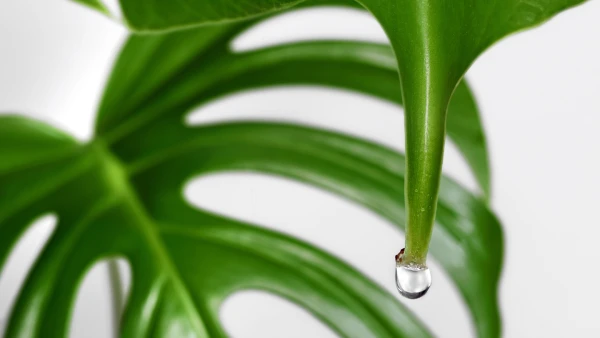
If you have noticed transparent droplets at the tips of the leaves, then you have witnessed monstera 'crying'.
"When humidity increases, the plant starts to cry, meaning moisture literally drips from the leaves, which is why monstera is popularly nicknamed 'the weeper'. It is believed that this indicates rain," says Alexander Khaburgaev.
The phenomenon commonly referred to as 'crying' in everyday life is scientifically known as guttation (from the Latin 'gutta' — drop). This is not an emotional reaction but a physiological process.
Guttation manifests as droplets of water appearing at the tips or edges of leaves. In monstera, this most often occurs before rain or on cloudy days. The mechanism of this phenomenon is related to the plant's water exchange. In a tropical climate, the soil is constantly saturated with moisture. The plant actively absorbs water through its roots, and it becomes difficult to evaporate it through the stomata (special pores on the leaves) due to the high humidity of the air. Under such conditions, increased pressure builds up inside the plant, and excess moisture along with dissolved minerals is expelled through special organs called hydathodes. This is how monstera's 'tears' are formed.
In the conditions of an urban apartment, monstera has retained this ability. Therefore, if the plant 'cries', it is a sure sign that the humidity has increased. This often foreshadows precipitation. Thus, monstera acts as a living barometer, helping to predict bad weather.
What to Do If Monstera 'Cries'
Monstera's 'crying' is a natural and harmless phenomenon. Generally, it means that the plant is healthy and functioning in its normal mode. This is its way of expelling excess moisture. In such cases, there is nothing to be done. It is not advisable to try to wipe off the droplets or, even more so, treat the leaves with any substances.
However, it is important to pay attention to the context and intensity of the process. If monstera 'cries' continuously, almost every day, and the droplets are large and abundant — this may not just be a reaction to humid weather, but a signal of a slight imbalance in care. In this case, what needs to be 'done' is not something with the droplets themselves, but something with the conditions in which the plant is kept.
Here are some points to consider and what can be adjusted:
- Watering. This is the most common cause of excessive guttation. The plant simply cannot 'drink' all the water that is offered to it. You can reduce the volume or frequency of watering. In winter, when the daylight is short and growth slows down, watering should be reduced particularly significantly.
- Air humidity. Paradoxically, in conditions of very high humidity, evaporation from the leaves slows down, and the plant has to expel water more actively through guttation. It may be worth ventilating the room a bit more often.
- Lighting. On cloudy days, the process of photosynthesis and, consequently, growth slows down. Meanwhile, watering may remain the same, abundant. The plant does not manage to use all the water and begins to actively excrete it. It may be worth moving monstera to a brighter location.
- Temperature. Sharp temperature fluctuations, especially drops, can also provoke active guttation. For example, if it becomes noticeably colder at night and watering has not been reduced.
Can Other Plants Predict the Weather?
Monstera is not the only natural weather predictor. The plant world is full of sensitive organisms that respond keenly to changes in the atmosphere.
For instance, various species of euphorbia, like monstera, contain a special sap, but their reaction to the environment may be different.
"Some acacia species fold their leaves on cloudy days to reduce surface area," adds Alexander Khaburgaev.
Some species, for example, poinsettia, react sharply to short-term drops in temperature. A plant subjected to cold stress usually sheds its leaves. In cases of frostbite and severe chilling, the flower dies.
Overall, many representatives of tropical flora, like monstera, are prone to guttation. This is a natural way to rid themselves of excess water and salts, especially in conditions where evaporation is hindered. Thus, the ability of plants to respond to changes in the environment is a result of adaptation to weather changes.