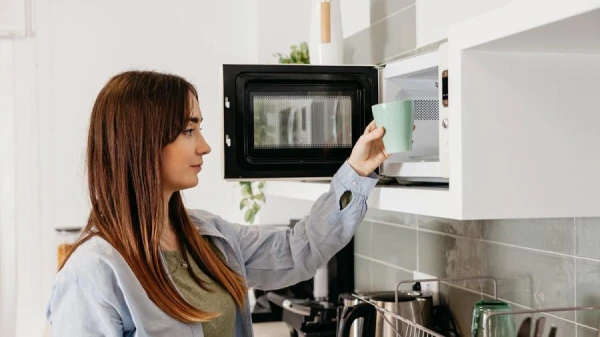
The microwave celebrates its 80th anniversary. This once-revolutionary, now familiar electrical appliance has evolved from a bulky device to an indispensable kitchen assistant, without which modern life is hard to imagine.
Despite its considerable age and widespread use, the microwave is still surrounded by a heap of myths and misconceptions. On this significant date, we decided to conduct a detailed analysis of the most persistent misconceptions regarding this device. However, among these stereotypes, there are also some truths.
Myth 1. The microwave was invented by accident
This is true. The history of one of the most common household inventions began with a curious incident. In 1945, American engineer Percy Spencer, working with a magnetron—a generator of ultra-high-frequency electromagnetic waves—discovered that a chocolate bar in his pocket had unexpectedly melted.
This observation became the starting point for a series of experiments. Spencer realized that he had encountered an unknown effect of rapid heating of food. The result of these investigations was a patent obtained in October 1945. Thus, thanks to curiosity and a chocolate bar, the story of the device that changed the culinary habits of millions of people began.
Myth 2: Food becomes "radioactive" after being processed in a microwave
Many still believe that the microwave "irradiates" food, making it dangerous to health.
"It is necessary to distinguish between concepts. The microwave radiation used in microwaves is not ionizing radiation, like gamma or X-rays. It is ordinary radio waves, the same type of radiation used in radio communication, broadcasting, and mobile networks, just with a different frequency and power," explains Doctor of Physical and Mathematical Sciences Anatoly Perminov. "The key point is that these waves cannot in any way affect the structure of atomic nuclei and make food radioactive. Their only effect is thermal. As soon as the device is turned off, wave generation stops, and the food simply retains heat."
Myth 3. Microwaves destroy vitamins
This statement is only partially true, as it is not the "dangerous" microwaves that are to blame for the destruction of vitamins, but the heating itself. That is, the very fact of temperature increase. During thermal processing—whether boiling, frying, or reheating in a microwave—some vitamins inevitably break down.
"But with proper use, the microwave can preserve more nutrients in food than traditional cooking methods. The main advantages are the speed of thermal impact and the reduction of cooking time, as well as the minimal amount of water needed for cooking. While during boiling, water-soluble vitamins are largely transferred to the broth, cooking in a microwave minimizes such losses," says Doctor of Physical and Mathematical Sciences Viktor Krishtop.
Myth 4: Reheating baby food in the microwave leads to the formation of toxins
This stereotype has no scientific basis, scientists explain. Electromagnetic waves cannot turn safe components of purees or baby formulas into toxic compounds.
The real danger that specialists point out is the risk of burns due to uneven heating. The product can develop so-called "hot pockets"—areas with temperatures significantly exceeding the overall temperature.
To ensure the safety of the child, after reheating, the food must be thoroughly stirred and allowed to sit for 1–2 minutes to equalize the temperature throughout the volume.
For gentle warming, it is better to use the low power or defrost setting.
Myth 5. It is categorically forbidden to heat water for tea or coffee in the microwave
There is an opinion that this leads to the "explosion" of water molecules and damage to the dishes.
"You can heat water, but it is important to understand the risk of overheating," warns Anatoly Perminov. "In smooth dishes, without chips and scratches, water can reach boiling temperature while remaining externally 'calm'. But as soon as you slightly move the cup, it can instantly boil explosively, releasing steam and hot water."
For safe heating, the expert recommends placing a wooden stirring stick, a tea bag, or using a mug with a rough bottom in the vessel. These will create nucleation sites for steam in the vessel, allowing boiling to occur calmly and in a controlled manner.
As for the "explosion" of water molecules, microwaves act differently. They cause polar molecules to rotate and vibrate rapidly. This results in friction between them, which leads to the release of heat.
Myth 6. You cannot place metal objects in the microwave
This is no longer a myth, but a harsh reality. There is a strict technical requirement for the operation of microwaves.
"Using metal dishes, cutlery, or foil is unacceptable," Viktor Krishtop emphatically states. "Metal reflects microwaves and heats up very quickly due to electric currents induced by electromagnetic waves. This leads to sparking, ignition of food, and can result in device failure or even a fire."
Even small metallic details, such as gilded rims on ceramics or "glitters" on plates, pose a danger. The scientist points out that there is special cookware certified for use in microwaves. It has a special design or protective coating and is always marked with the appropriate symbol.
Myth 7. Microwaves can sterilize objects
As scientists note, a damp kitchen sponge treated in a microwave at full power for two minutes becomes practically sterile. The high temperature of the steam generated inside the sponge kills up to 99% of bacteria.
But it should be remembered that this method only works for damp items. For dry products or in the absence of moisture, this method does not work, as microwaves act specifically on water.