
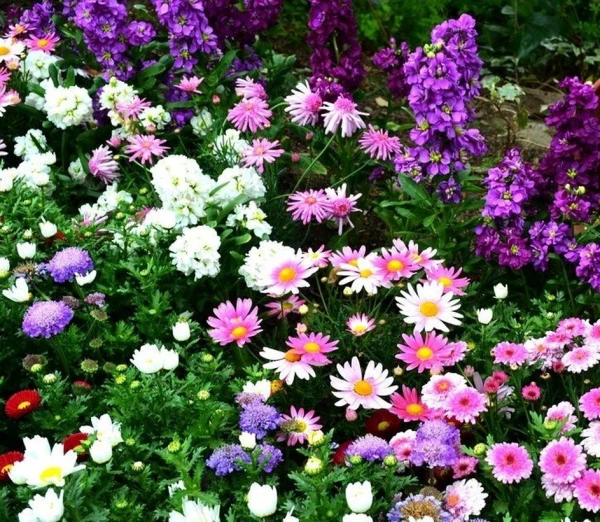
The secret to a successful flower bed lies in the proper selection of plants. To create the most beautiful flower bed, perennials and bulb flowers are needed, as well as free space in the area.
It is important to choose plants so that they bloom, replacing each other.
Plants that Bloom in Spring
The garden is incredibly beautiful in spring. Bulbous plants — bright tulips and delicate daffodils — are especially lovely at this time. Among the early-blooming perennials, the beautiful peony attracts attention.
Perennials
Peony
The peony belongs to the class of perennial plants and can be herbaceous, semi-shrubby, or shrubby.
Peonies bloom at the end of spring for 8 to 25 days, depending on the variety.
Due to their hardiness, peonies can grow in one place for a long time, so it is important to choose a suitable spot in the garden for them. It should be sunny, the soil should be loamy and slightly alkaline, and sand must be added to the soil.
Euphorbia
Garden euphorbia is widely used by gardeners for landscaping homes and gardens and is loved for its hardiness and vast variety of unique forms.
The flowers of euphorbia are inconspicuous, but the leaf blades are bright and unusual, often mistaken for flowers. In May, euphorbia blooms with multi-flowered, marsh, almond-shaped, and cypress varieties.
Aquilegia
Also known as columbine — a beautiful flowering herbaceous perennial of the buttercup family. The plant has attractive compact bushes.
Aquilegia prefers slightly shaded areas with moderately moist, loose, and fertile soil. It can also be grown in sunny spots, but in this case, the flowers will be less vibrant. It tolerates drought well.
Bulbous Plants
Tulips
The tulip belongs to the lily family. It has a very short growing season, blooming from the first half of March, depending on the temperature.
Tulips prefer sandy soils with low acidity or neutral. Poor soil can be enriched with compost. The chosen area should have plenty of light, and there should be no tall trees and shrubs or standing water.
Daffodils
The daffodil is one of the bright symbols of spring and beauty.
Daffodils are easy to grow; it is important to plant the bulbs correctly and choose a suitable planting location. The flower prefers sunny and slightly shady spots. The soil should be fertile and slightly acidic.
Plants that Bloom in Summer
Among the perennials that bloom in summer, there are several unusual plants that can help create stunning compositions. And don’t forget about summer-blooming bulbs like gladioluses.
Perennials
Acanthus
Acanthus belongs to herbaceous perennials. The flowers are small, white, pink, red, or purple with bright spiny bracts.
Acanthus does not tolerate transplanting well, so the planting site should be chosen considering all the plant's preferences. A well-lit area protected from drafts is optimal, as well as having root restrictions, since they can spread very widely.
Bulbous Plants
Gladioluses
Early varieties of gladioluses bloom as early as late spring, while late varieties retain their decorative qualities until late autumn.
Gladioluses are planted in spring in a spot that is sufficiently sunlit, as only then will the plant produce beautiful inflorescences. Gladioluses prefer clayey-sandy, humus-rich soils and do not like boggy and wet grounds, as planting in such substrates will lead to the plant's demise.
Crocosmia
A bulbous perennial plant from the iris family that is very popular with gardeners and florists.
Powerful flower stalks with dense spike-like or panicle inflorescences bloom on the stem. The buds open sequentially, producing a dozen bright flowers. Blooming begins in mid-summer.
The plant's location should be well-lit by the sun. Crocosmia thrives better in rich, loamy, and moist soil.
Plants that Bloom in Autumn
In autumn, the flower bed will be decorated by late-blooming perennials such as dahlias and anemones, which will continue to bloom until the first frosts.
Perennials
Dahlias
A perennial herbaceous plant of the aster family is one of the most popular flowering plants for outdoor cultivation.
Dahlias bloom in all colors except black and blue, from summer to autumn and until frost.
Growing dahlias will not cause much trouble. It is important to choose a sunny planting location. The flower needs watering, weeding, and tall varieties require staking. It is important not to overdo it with fertilizers to avoid delaying blooming.
Japanese Anemone
Belongs to the buttercup family. Due to its hardiness, the Japanese anemone easily adapts to planting in different soil types and does not require complex care. It begins to bloom in August and ends in October.
The plant feels good in open, well-lit areas. However, some varieties tolerate partial shade well, and in the south, it is better to plant them in shaded parts of the garden during the day. Care involves watering and mulching the soil. In autumn, the plant is pruned.
Bulbous Plants
Colchicum
A genus of perennial flowering plants from the colchicum family. This herbaceous bulbous plant grows to 20-25 cm in height with large solitary flowers of light pink or purple color. It blooms in September-October.
Colchicum is light-loving but tolerates occasional shading. When planting, avoid overly wet and dry places. It is undemanding in care.
Plants that Bloom in Winter
Winter is the most challenging time to maintain the productivity of a flower bed, but hellebores will allow you to do this.
Perennials
Hellebore
A plant of the buttercup family, also known as Christmas rose or winter rose. It is a perennial, evergreen herbaceous plant with quite large flowers. Depending on the species, the first flowers may appear in winter, while the latest varieties can be seen in May.
Hellebore prefers semi-shaded or shady places, protected from the wind. It thrives in humus-rich, moist soils with good drainage. It is frost-resistant. It can grow in one place for up to 10 years.












Leave a comment