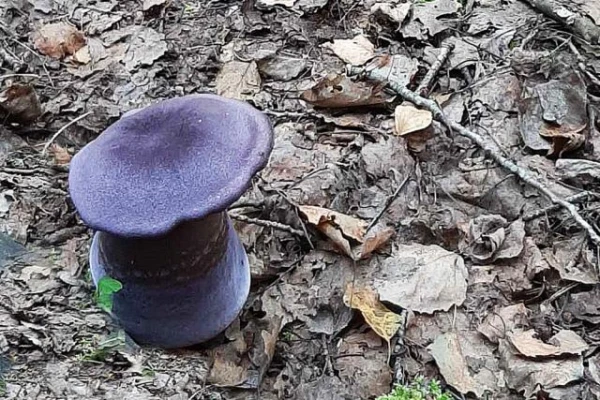
The world of mushrooms is diverse and whimsical. Nature, the trickster, has created forest gifts that amaze in shape, color, and taste. A vivid confirmation of this is the purple mushrooms. If a child were to draw such, they would be called a dreamer.
Such are the realities of the modern world that a person is increasingly distancing themselves from nature, losing knowledge of many of its processes and phenomena. As a result, what is obvious is becoming more and more incredible.
Purple Mushroom
This statement fully applies to a rather rare mushroom, the purple cortinarius. By endowing this species with an unusual color, it is unlikely that the creator thought that such a colored cloak would become the main protective element of the mushroom. Moreover, the unusual color scares modern foragers, serving as a harbinger of possible poisoning.
In reality, the purple cortinarius is not just edible, but very tasty in any form. Moreover, it does not even require preliminary boiling before frying, which also frightens foragers, as boiled mushrooms turn the broth a frightening inky black color.
This purple wonder was first described in 1753 by the famous Swedish scientist Carl Linnaeus. Seventy years later, thanks to British chemist, pharmacologist, and botanist Samuel Greville, this species of mushroom received its international scientific name.
The name "cortinarius" comes from the Latin "cortina" for the veil between its cap and stem, and in relation to its color, a parallel is drawn with the violet.
Mushrooms grow in both Eurasia and North America from August to the end of October. They can be found in mossy forests of coniferous and deciduous trees, especially near pines, birches, and aspens. Justifying their close relation to champignons, they grow in small groups in the same places.
The mushroom cap is initially hemispherical and then becomes flat-convex. It reaches a diameter of 15 cm, while the stem is 12 cm tall and 2 cm thick. The mushroom feels dry and velvety with tiny scales. It is the young mushrooms that clearly display a web of purple-blue color. The flesh of the mushroom is also purple, meaty, and brittle, with a pleasant nutty aroma.
In general, when encountering purple mushrooms in the forest, they should not be cut due to the fear of poisoning. The opportunity to see such a natural masterpiece again and again will provide much brighter emotional experiences.