
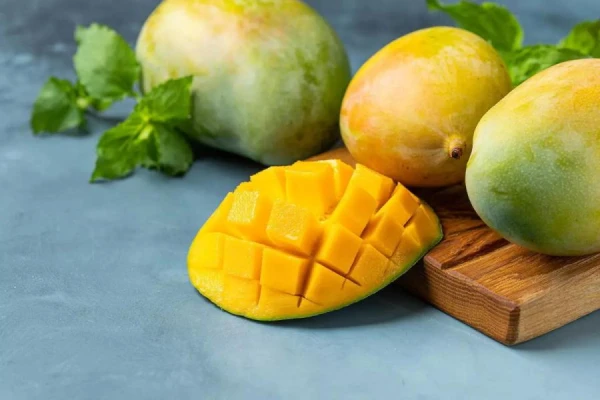
Mango has become an accessible fruit that can be found in any store. However, buyers still have questions. Which mango variety is the sweetest? How to choose a ripe fruit and properly peel it to avoid losing part of the flesh? You will find all the answers in this article.
Diversity of Mango Varieties: What to Pay Attention To
Yellow Mango
The main suppliers of yellow mangoes in the Russian market are Thailand, Vietnam, and China. Thai mangoes are available year-round, but their peak sales occur in spring, so it is best to purchase this fruit from March to May. It is characterized by large size, slightly elongated shape, and sweet, buttery flesh. Chinese varieties can be either small and round or elongated. Yellow mango is perfect for making smoothies.
Green Mango
Most green mango varieties have a slight tartness. The sweetest of them comes from Egypt from late summer to mid-December. Egyptian mango is large and elongated, with tender flesh and pine notes in its flavor. Small green fruits are usually imported from Brazil and Israel. Even when ripe, they have a crunchy and slightly sour fibrous flesh, but they most often reach the shelves in an unripe state. They are also significantly cheaper than others. Green mangoes with tartness are excellent for salads, for example, with arugula and soft cheese.
Red Mango
This variety is essentially green, with red or orange blushes. The main supplier is Peru, where the mango season lasts from January to March. The fruits are small and round, tasting similar to yellow mangoes but less buttery.
How to Choose Mango
Regardless of color and size, mango should be soft to the touch and have a pleasant aroma. Avoid fruits with damaged or wrinkled skin, as well as those with a smell of alcohol or acidity, which indicates that the fruit has overripe and started to ferment.
Some varieties of yellow Thai mango may have small black spots on their skin. These indicate the ripeness of the fruit, so there is no need to be afraid of them.
How to Help Mango Ripen at Home
Place unwashed mango in a paper bag and leave it at room temperature for a few days. In the warmth, the fruit releases ethylene gas, which accelerates the ripening process. The same effect can be achieved by placing mango in a pot of dry rice without covering it.
For the most patient, there is an option to leave the fruit in the sun for five to ten days. However, any home ripening methods do not guarantee that the mango will become sweet, so it is best to buy ripe fruits right away.
How to Properly Peel Mango
The main drawback of mango is its large flat pit, which prevents cutting the fruit into two halves. Therefore, it is best to proceed as follows:
* Do not peel the fruit. Place it on a cutting board with the stem side down and make longitudinal cuts, dividing it into three parts: the two outer ones will have skin, and the central one will have the pit in the middle.
* The outer halves can be eaten with a spoon or cut into a grid down to the skin and carefully separate the flesh with a knife to get perfect cubes.
* The piece with the pit can be eaten or the remaining flesh can be cut off with a knife. The pit can also be used as a peeling: gently rub it on clean facial skin in circular motions and wash your face after five to seven minutes.
* The flesh of mango rarely causes allergies, unlike the juice and skin. Therefore, it is better for allergy sufferers to peel the fruit while wearing gloves.
Five Health Benefits of Mango
1. Quick Hunger Satisfaction
Both yellow and green mango are great snacks. They have relatively low calorie content (only 65–70 kcal per 100 g), but are high in fiber and sugars that quickly replenish energy.
2. Vitamin C for Fighting Colds and Inflammations
One mango contains the daily dose of vitamin C, which promotes the production of antibodies, helping the body resist infections. In combination with the triterpenoid lupeol, it combats inflammatory processes. Unripe fruits contain even more vitamin C than ripe ones.
3. Carotenoids and Zinc for Skin Health
The bright yellow color of mango flesh is due to carotenoids, which are precursors to vitamin A. In combination with zinc, they accelerate wound healing and help combat acne and rashes. Vitamin C also plays a role in collagen production, making the skin firmer and more elastic.
4. B Vitamins and Magnesium for Improving Mood
The color of mango is already a great antidepressant. Magnesium and B vitamins strengthen the nervous system, help cope with stress, and reduce symptoms of anxiety and chronic fatigue.
5. Fiber and Polyphenols for Normalizing Digestion
The combination of fiber and water in mango improves stomach motility and normalizes digestion. Polyphenols, particularly gallic acid, promote the increase of beneficial lactobacilli colonies in the intestines and reduce inflammatory processes in the digestive tract.
Why Mango Should Not Be Combined with Alcohol
Mango enhances alcohol intoxication due to myrtillin and myrcene, which accelerate the absorption of ethanol. The flavonoids in the fruit can increase the toxic effects of alcohol on the liver.
Do not use mango and its juice to prepare alcoholic cocktails, and during gatherings, refrain from desserts with this fruit.













Leave a comment