
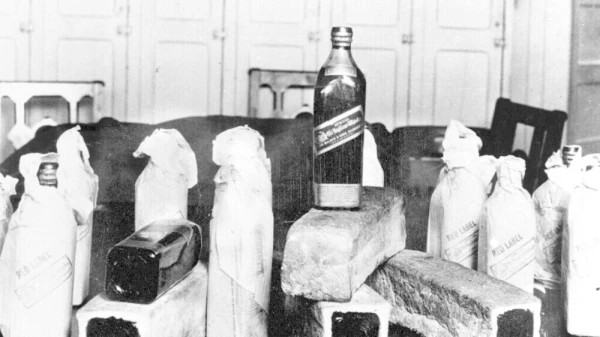
Franklin Delano Roosevelt signed a law that again allowed the production and sale of beer.
The history of Prohibition in the USA is one of the vivid examples of how good intentions lead to unforeseen consequences. Officially called the "Noble Experiment," this period of banning the production, sale, and transportation of alcoholic beverages did not become a time of universal sobriety and moral cleansing, but rather an era of rising corruption, violence, and organized crime.
When it comes to Prohibition itself, its roots go deep into American history. The temperance movement, fueled by religious Protestant communities that saw drunkenness as a sin and a threat to the family, and feminist organizations fighting against the consequences of alcoholism for women and children, gained momentum throughout the 19th century. The pinnacle of this struggle was the creation of the Anti-Saloon League, which turned into a powerful political lobby. Using patriotic sentiments during World War I and xenophobia towards new immigrants from Europe, whose cultures included the consumption of wine and beer, supporters of Prohibition achieved their goal. On January 17, 1920, the Eighteenth Amendment to the U.S. Constitution and the Volstead Act came into effect.
But society did not comply. Prohibition did not breed submission; on the contrary, it fostered ingenuity and defiance. Numerous loopholes were immediately found. Alcohol, for example, was prescribed by doctors for medical purposes, leading to an explosive growth in the number of "wine pharmacies," while priests purchased giant batches of "sacramental wine" for communion. In every major city, especially in New York and Chicago, underground bars began to appear, accessible by acquaintance or by saying a code word. Americans took to home distilling.
However, the real golden age came for bootleggers. Alcohol was secretly shipped by sea from Canada, the Bahamas, and the Caribbean, and then distributed across the country. It was on this wave that those whose names became synonymous with the era rose: Al Capone, Meyer Lansky, Bugsy Siegel, Charles Lucky Luciano.
Until the 1920s, organized crime was fragmented and mostly local, represented by gangs involved in racketeering, robberies, and gambling. Prohibition became an economic stimulus for their growth. Bootlegging required complex logistics—organizing supplies, transportation, warehouse security, distribution networks, and, most importantly, protection from competitors and corrupt connections in the police and government. Random gangs were unable to handle such a scale of operations. Thus began the formation of strictly hierarchical criminal syndicates, built on corporate principles, with clear divisions of responsibilities and areas of influence. Italian, Irish, and Jewish groups began to form temporary alliances to control territories. It was during this period that the famous Cosa Nostra with its families and Committee, which served a sort of board of directors function, but only in the criminal world, was born.
The profits were enormous. According to official estimates, Al Capone earned up to $60 million a year from bootlegging. This money flowed like a river and corrupted all levels of power. Police officers, earning salaries far less than what gangsters offered, turned a blind eye to illegal activities or warned about raids. Judges took bribes or found themselves under the threat of physical harm. Politicians and city mayors were funded from criminal coffers.
Such incomes inevitably led to bloody wars. The streets of big cities turned into arenas of shootouts and explosions, with victims not only being gangsters themselves but also innocent bystanders.
By the early 1930s, it became clear even to the most ardent supporters of Prohibition that the experiment had completely failed. Public morality did not strengthen; instead, crime and corruption flourished.
The government lost billions of dollars in potential taxes from the legal alcohol industry, and the Great Depression of 1929 sharply raised the question of the need for new jobs and replenishing the treasury.
As a result, in 1933, immediately after taking office, President Franklin Delano Roosevelt signed a law that again allowed the production and sale of beer, and on December 5 of the same year, the Twenty-First Amendment to the Constitution was ratified, repealing the Eighteenth.
However, its most terrible offspring—organized crime—did not disappear. The Mafia simply redirected its focus to other areas: gambling, control over unions, usury, and later drug trafficking. They also continued to use connections with politicians and law enforcement.
Thus, Prohibition not only complicated the lives of ordinary Americans but also created a criminal empire that lives by its own laws within the state, the consequences of which the USA continues to fight to this day.













Leave a comment