
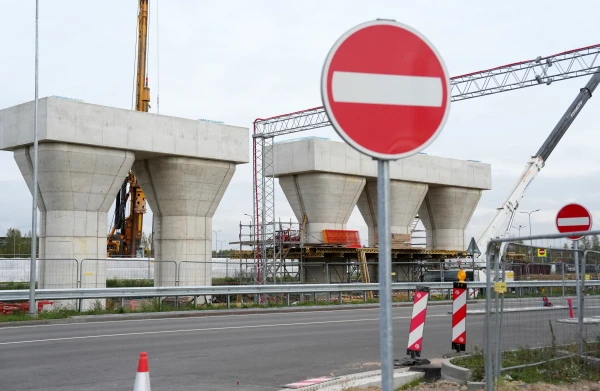
The completion of the European narrow-gauge railway Rail Baltic, connecting the Baltic countries with Poland, by 2030 is extremely unlikely, stated the head of the Latvian parliament's commission investigating the Rail Baltic project at hearings organized by the special commission of the Estonian Riigikogu to combat corruption.
The deputy emphasized that none of the three Baltic countries will be able to prepare their section of the railway by that time, ERR reports.
In particular, the Latvian part of the project lacks 4.4 billion euros to cover expenses, and the greatest difficulties are associated with the construction of the section running north from Riga to Salaspils, the detailed design of which has not even begun.
There are difficulties related to the construction of a bridge over the Daugava River, as there are only seven cranes in the world for installing bridge elements, and none of them are in Europe.
According to the Latvian deputy, 2030 is an unrealistic deadline. The construction of the railway can, at best, be completed in 2034-35.
Anvar Salomets, the chairman of the board of Rail Baltic Estonia, who attended the hearings, acknowledged in his presentation that although there are risks associated with completing the railway on time, it is technically feasible in Estonia, where 100 kilometers of railway are already under construction.
Salomets also noted that the cost of one kilometer of railway in Estonia is comparable to the cost in Lithuania and significantly lower than in Latvia, which may be due to the fact that in Estonia, construction tenders were conducted in parts, rather than handing the entire project to one company, as was done in Latvia.
Anastasia Kovalenko-Kylvart (Center Party), the chair of the special commission of the Riigikogu to combat corruption, justified the hearings by stating that at the end of last year, information was received that Latvia was looking for ways to reduce the Rail Baltic project, resulting in a 60-kilometer section of railway between Riga and Estonia potentially remaining on the old track. This, in turn, would mean that Rail Baltic would not operate as planned.
According to Kovalenko-Kylvart, the special commission on combating corruption wanted to obtain an overview of the current state of the Latvian part of the Rail Baltic project and the possible prospects for the entire project as a whole.













Leave a comment