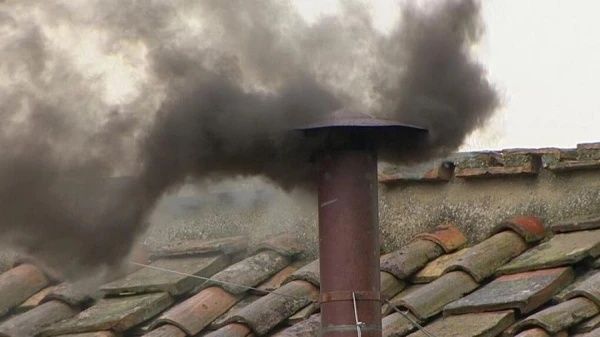
Almost daily, reports come from various corners of Latvia about cases of fires in the chimneys of private homes. Burning soot is a seasonal problem: in autumn and winter, rescuers have plenty of calls. However, in summer, when the causes of problems should be addressed, chimney sweeps receive very few requests, reports the program "Degpunktā" (TV3).
In Alūksne, soot caught fire in the chimney of a residential building. Local resident Dace captured the moment when flames erupted from the pipe instead of smoke.
"We were returning from kindergarten, having dropped off the kids. We were walking back, and people were already standing by this house and called the firefighters," Dace said.
Fortunately, no one was injured in the incident, and this is just one of countless fires during the winter season, caused by untimely cleaning of chimneys. The proper condition of the chimney is a mandatory requirement for all homes where solid fuel heating is actively used. Not everyone can climb onto the roof and clean the pipe themselves, so this task, which is crucial for life and property safety, must involve chimney sweeps.
Masters of this craft have been working in Latvia since the Middle Ages, and as part of an organized society since the 18th century. They emphasize the importance of timely maintenance of chimneys.
"In summer, people think too little about the saying 'prepare the sleds in summer.' If everything is not put in order, the consequences will not be long in coming," said chimney sweep Maris Bambis.
Maris notes that in autumn, chimney sweeps are very busy because that is when people suddenly remember that the chimney needed to be cleaned. He urges not to wait for autumn and to remember that there are not many specialists in this field in Latvia. Therefore, as soon as winter ends and spring begins, he asks to consider how the chimney feels after months of cold:
"We can only urge not to rely on insurers and smoke detectors. Everything needs to be done in advance to avoid disaster."
The master notes that in recent years, Latvians have become much more responsible about cleaning the chimneys in their homes. Nevertheless, the statistics collected by firefighters are not very encouraging — the number of fires caused by dirty chimneys is counted in the hundreds.
"Every heating winter, we meet with slight concern. This year, in the first nine months, there were 229 fires related to heating devices, as well as 261 reports of burning soot," said Agris Asups, commander of the 1st part of the Riga Fire and Rescue Service.
While soot can still be removed from chimneys, thereby eliminating the risk of blockage, the heating system itself is much more complicated. Fires often occur due to unnoticed defects in the pipe or stove, which are difficult to notice in everyday life, and after a fire, residents often do not understand what exactly caused the fire.
However, just as one can call a chimney sweep, one can also invite a specialist to check the stove and heating equipment. However, rescuers are most perplexed by the category of fires caused by the inability to use the stove or negligence.
"Rather, it is not negligence, but indifference. We have seen cases where the stove is not connected to the chimney. It is also not allowed to place flammable items on the stove. And firewood should not be left by the stove door either," firefighters warn.
An unattended lit stove, open doors, or flammable materials nearby — all these causes of fires can be prevented through human caution. Firefighters and chimney sweeps remind us: when using solid fuel heating, one must be especially careful, as it often seems that "it won't happen to me" when observing the misfortunes of others.