
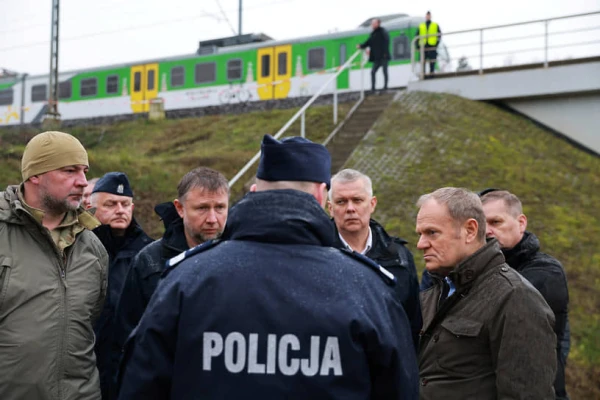
The journalistic experiment revealed shocking trends.
"Quick and easy money." This is how advertisements that conceal arson, sabotage, and work for Russian special services might look. In Poland, such offers are widely spread through Telegram — under the guise of regular job searches.
Journalists from the portal "Vot Tak" conducted an investigation and uncovered a whole network of recruiters operating in popular Telegram chats. Their goal is to find performers for sabotage both in Ukraine and on Polish territory.
"We wanted to understand how exactly the saboteurs who have already carried out attacks were recruited. We tested the hypothesis: could they have been found through Telegram job vacancy chats," says Maxim Shilin, the editor-in-chief of the portal "Vot Tak."
The investigation began with the analysis of dozens of job search chats. Two of them are administered by a team with a strikingly alarming name — Bomba Poland Media. Each has between 6,000 and over 10,000 subscribers. For a fee, one can automatically post advertisements on behalf of fake accounts.
"To publish an ad, you just need to pay. The price is open, everything is automated. And then, on behalf of a profile — most often with a fictitious name and no photo — a 'vacancy' appears," says Shilin.
The texts of such advertisements are maximally primitive: "Need a job? Write to us. Fast and easy." No conditions, no requirements. Just a contact — and it leads to the next stage of recruitment.
Journalists found out that all advertisements led to just four recruiter accounts. It is they who directly offered 'jobs' — arson, sabotage, attacks on infrastructure.
"We were offered to burn cars with Polish license plates — preferably expensive ones from the luxury segment. It was mandatory to film it on video," says Maxim Shilin.
A separate 'order' involves the arson of cars that volunteers purchase for the Ukrainian army.
"These cars are easy to identify. They are transported on trailers, they look distinctive. And money is also offered for their destruction," he explains.
The main bulk of tasks concerned Ukraine: arson of cars belonging to military recruitment centers, attacks on military enlistment offices, police, courts, and sabotage on the railway.
The price of the issue ranges from $750 to $1500. Payment is made in cryptocurrency, euros, or via bank transfer. But, as Shilin emphasizes, there are no guarantees.
"There is no certainty that you will even be paid. Most likely, such people are used as disposable agents," he says.
Moreover, the very method of 'working' almost guarantees arrest: arson, filming on video, being detained at the crime scene.
According to the Polish Internal Security Agency, since the beginning of the full-scale war of Russia against Ukraine, the number of acts of sabotage and arrests for collaborating with foreign intelligence services has been increasing in the country. More than 60 criminal cases are already related to espionage and preparation for sabotage.
Most often, citizens of Belarus and Ukraine are detained.
"There are very few Russian citizens in Poland — about 30,000. However, Belarusians and Ukrainians live here in large numbers, and they are the focus," notes Shilin.
The profile of a typical performer, according to intelligence services, looks alarmingly familiar: a young person, financially vulnerable, sometimes with a criminal past.
"The most striking thing is that many of them declare anti-Russian views, but this does not prevent them from carrying out tasks against Ukraine and European countries," says the editor-in-chief of the portal "Vot Tak."
Although the entire chain is carefully tangled — VPNs, IP addresses across several continents, anonymous accounts — its origin raises no doubts. The roots are in Russia.
And that is why journalists urge maximum vigilance.
"If the job advertisement does not specify conditions — that should already raise suspicion. Attention today is a matter of security," summarizes Maxim Shilin.
Most residents of Poland are skeptical about the prospects of ending the war in Ukraine in the near future. According to a survey conducted by the IBRiS institute for the newspaper Rzeczpospolita, 59.6% of respondents do not believe that the war will end in 2026. The opposite opinion is held by 21.6% of those surveyed.
According to the results of the study, 45.9% of survey participants believe that the war "most likely will not end" in 2026, while another 13.7% are convinced that it "definitely will not end." At the same time, 18.3% of respondents believe that the war "most likely will end," and 3.3% are confident in its conclusion. Another 18.8% of those surveyed could not decide on an answer.
The newspaper notes that among those who do not expect the war to end in the coming year, supporters of the ruling coalition prevail, but the share of opposition supporters in this group is only slightly smaller. They most often cite YouTube channels and podcasts as sources of information about the international situation.
"Poles remain realists," commented the survey results for Rzeczpospolita former head of the National Security Bureau of Poland, General Stanisław Koziej.
In turn, former commander of the GROM special unit, General Roman Polko, noted that Poles do not trust statements made by Vladimir Putin. At the same time, he emphasized that the results of possible peace negotiations between the USA, Ukraine, and Russia remain unknown.







Leave a comment