The local product is of high quality, but its production requires hand-picking.
Rwanda maximizes the advantages of its hilly landscape and helps small farmers increase the production of high-quality tea.
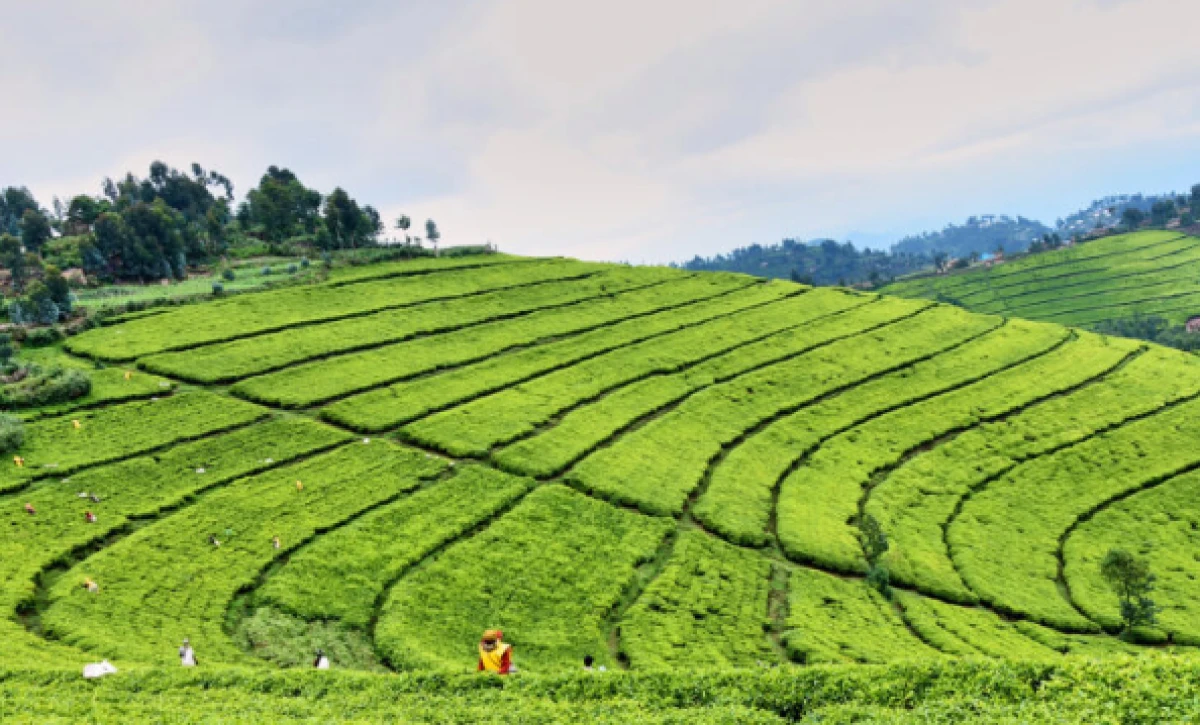
Over the lush green fields of the Land of a Thousand Hills, dawn is breaking. With the rising sun, the light mist enveloping the hilltops begins to dissipate, marking a new day for Rwanda's agricultural workers.
The tea leaves shimmer in the rays of the rising sun, and the tea pickers don bright yellow overalls that protect them from scratches as they weave between the green rows of tea bushes. Each picker has a woven basket slung over their back, into which the skillfully plucked leaves are placed. To the melodious singing of birds that fills the air, the tea pickers in yellow overalls move briskly and in unison along the planted rows of bushes. Thanks to their daily efforts, tea has become Rwanda's second-largest export after coffee.
The agricultural sector in Rwanda is the backbone of the economy of this landlocked country in East Africa: it is estimated that 64.5% of the population is employed in this sector, which accounts for 27% of the gross domestic product (GDP).
Tea production has changed the lives of many rural communities in Rwanda.
More than 83% of Rwanda's agricultural output is produced by small farmers, including in the Nyaruguru region located in the south of Rwanda, where tea is grown.
"I am proud to own a tea farm. I used to always work for someone else, but now I provide jobs for others," notes Bertrid Niyiranzigiyé, a 65-year-old female farmer who began growing tea on her plot of just under one hectare in 2018, when the government, in collaboration with local farmers, began developing tea production in the region.
Now, the Nyaruguru region, which was chosen for the expansion of tea production, attracts people from other areas who come to work and earn money by picking tea.
Ndagijimana Jean Marie Vianney, a 39-year-old tea farmer from Nyaruguru and father of four, recalls: "Our family lived so poorly that we could barely make ends meet. Then I noticed that tea farmers were doing well, and I decided to get into tea production too. I really wanted to finally escape poverty."
Jean underwent training through a special program organized by the government and decided to plant tea on his field, which previously grew sweet potatoes.
"By starting to grow tea, I was able to lift my family out of the poverty we lived in before. Now I can buy clothes and health insurance for my family. I can pay for my children's education. Our meals have also become more varied. And all this is thanks to tea cultivation." He believes that his children will also be able to continue tea production in the future, as it is a perennial crop.
Tea was first brought to Rwanda in the 1950s, but its production only began to actively develop in recent decades. Rwanda's climate, with its abundant rainfall and many sunny days, gentle hills, and mineral-rich volcanic soils, creates an ideal environment for tea cultivation.
The Food and Agriculture Organization of the United Nations (FAO) is working with the Rwandan government to develop a national tea production strategy aimed at improving its quality, as well as assisting the country in meeting international standards and gaining access to the most suitable markets.
This strategy identifies several areas that require improvement, including intensifying research and innovation, developing infrastructure, organizing continuous farmer training, and increasing the sector's attractiveness to youth. The key to its success is collaboration with farmers to produce high-quality tea varieties for niche markets.
Sandrine Urugwiro, senior operations officer at the National Agricultural Export Development Board of Rwanda (NAEB), spoke about this strategy: "Rwandan tea is of high quality, but its production requires hand-picking and ensuring that farmers select good leaves."
According to Urugwiro, strong links between small farmers, cooperatives, and tea processing enterprises play a crucial role in the development of this sector.
"Tea farmers are pleased that there is now vertical integration in the tea industry, allowing them to profit. Our farmers receive 50% of the tea sale proceeds. They go directly to the farmer. For example, if exporters sell tea through direct sales or at auction, we ensure that farmers who produce high-quality tea receive fair compensation. This way, they can reinvest the funds into tea production."
These small tea producers form the backbone of Rwanda's tea sector, where women play an important role. The number of women owning tea farms in Rwanda is increasing, and they also make up a large portion of tea pickers and factory workers. With plans to expand activities aimed at creating added value and developing related sectors such as agritourism, their share will only grow.
According to FAO representative in Rwanda Mahamed Au-Dahir, in this International Year of Women Farmers, we are honoring women farmers like Bertrid Niyiranzigiyé from Rwanda: "In Rwanda, women are the main driving force behind agricultural production: they actively participate in production processes, farm management, and product processing. It is important to note that the government is fully committed to empowering women farmers, and the FAO is actively involved in this process."
Women and men work side by side not only in the fields of Nyaruguru but also in many other regions of Rwanda, hand-picking only the most tender and freshest top tea shoots. These are used to produce higher quality tea, which is sold at higher prices and supports the dynamic development of rural communities across the country.
<iframe width="560" height="315" src="https://www.youtube.com/embed/2ulav_P1xw4?si=-5d62KGQ9PKSOj07" title="YouTube video player" frameborder="0" allow="accelerometer; autoplay; clipboard-write; encrypted-media; gyroscope; picture-in-picture; web-share" referrerpolicy="strict-origin-when-cross-origin" allowfullscreen></iframe>