

The most confident about the future turned out to be employees of unprestigious professions.
Forbes reviewed the first scientific study in Russia linking the growth of the HH index (a labor market indicator calculated monthly by HeadHunter, reflecting the tension in the labor market through the ratio of active resumes to job vacancies) with the risk of automation of professions. The analysis conducted by experts from the Zerocoder University revealed a direct correlation: the higher the likelihood that a profession will be replaced by AI, the sharper the competition for jobs in that field. The study covers 23 professional areas of the Russian labor market and 76 professions.
The most intense competition for jobs is observed in the fields of strategic consulting, management, and media communications. Executive management stands out particularly: with an average automation risk of 40.6%, the HH index here is anomalously high at 27.1. "This indicates that the market is oversaturated with strategists and managers regardless of AI risks, meaning there are significantly more candidates than available positions," the authors of the study explain.
In the field of information security (automation risk - 11.7%, HH index - 14.9) and jurisprudence (27.5% and 15.8 respectively), the situation is the opposite: the threat of automation is low, but competition for jobs is high. The authors believe the reason is the oversupply of graduates in these fields: universities are training specialists in numbers greater than the market requires. The highest risk of automation in the sample is associated with professions related to content creation, analytics, and coordination.
Thus, physical professions are more protected from automation than "intellectual" ones. "Industrial robots primarily replace technical personnel, while generative AI is increasingly being used in areas that were once considered 'safe havens' — jurisprudence, finance, creativity, and teaching," the study states. "In other words, white-collar workers are under threat: specialists whose work is based on analyzing texts, numbers, and ideas, which is precisely what modern neural networks excel at."
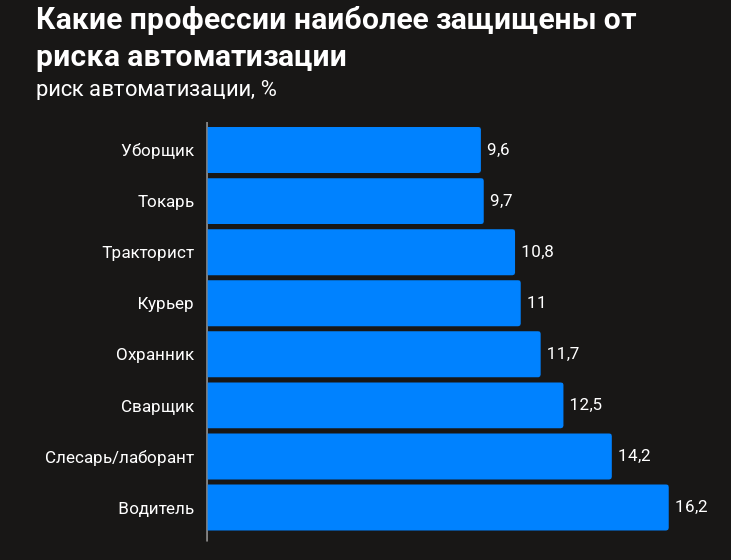
The Russian labor market of 2026 is experiencing an unprecedented phenomenon, the authors of the study note: official unemployment remains near the minimum of 2–2.2%, yet the number of job seekers on online platforms has sharply increased. Moreover, by 2026, AI will take on a workload comparable to 1–1.5 million jobs in Russia — about 1–2% of the labor market, experts indicate, who believe that routine processes such as document flow, processing inquiries, and initial data analysis are subject to automation.














Leave a comment