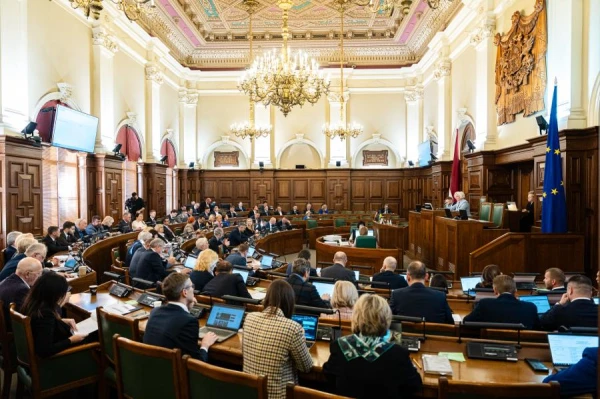
In the new government of the republic, however long it may last, there will be no Armands Krauze, who held the position of Minister of Agriculture since September 2023. This is a significant blow to the Union of Greens and Farmers, of which the chairmanship belonged to the former member of the government for the last 7 years, after the departure of the long-time leader Augusts Brigmanis.
Not Delayed for Long
One way or another, it’s better than ending up behind bars. In March 2026, the Prosecutor General's Office initiated a criminal case on charges of committing criminal offenses related to the illegal provision of support to logging companies, which led to losses for the state-owned company Latvijas valsts meži.
On May 14, 2026, Latvian television, citing information confirmed by the prosecutor's office, reported that the suspect Krauze was "temporarily detained for procedural purposes." As part of the same criminal case, the KNAB supported the prosecutor's office, and Raivis Kronbergs, the former state secretary of the Ministry of Agriculture and director of the State Chancellery, was also detained.
But a week later, A. Krauze was re-elected as a member of the Saeima...
"Reduction of Negative Influencing Factors"
The authorities recognized that a shadow had descended over the country's forestry sector at a meeting on December 19, 2023. The Ministry of Agriculture, as the curator of logging, noted that Latvian logs from the most sought-after wood – spruce – cost one and a half times more than in Sweden! Accordingly, 116 and 77 euros for one trunk with a diameter of 18-28 cm, with long-term supply. Thus, there was a "discrepancy with the regional market price."
Consequently, the volumes of processing also fell – if in the blessed, COVID year of 2021, Latvian sawmills produced 4,252 thousand cubic meters, then in 2023, only 3,541 thousand. Of course, this was also related to the overall decline in demand – during the corona crisis, the authorities of all countries dispersed so-called "helicopter money" in the economy, which was primarily invested in construction, stimulating demand.
"Assessing the situation in the timber markets as a whole," concluded the Ministry of Agriculture in May of this year, "it can be concluded that purchasing power in the markets for timber products has not increased, construction of residential buildings, which mainly use wood products, is decreasing, and according to Euroconstruct forecasts, this decline will continue until 2026."
Similarly, employment in the sector began to decline – if in August 2022 there were 8,012 workers in woodworking, furniture making, and related professions in the country, by January 2024, there were only 7,167.
The number of operators in wood processing and paper production decreased from 3,252 to 2,812.
In the Fight Against Beetles and Foresters
The state forestry concern had long been considered a model enterprise. This year, however, it seems that the Ministry of Agriculture began to have doubts about it.
The harmful bark beetle, also known as the large spruce bark beetle, has contributed to this – the main and most aggressive pest of spruce forests in Latvia. It accounts for up to 99% of all damage to coniferous plantations. Due to climate warming and an abundance of mature spruce forests, the population of the bark beetle is rapidly growing. The scale of the damage is so great that the State Forest Service (SFS) regularly declares emergencies in dozens of municipalities in Latvia to carry out urgent sanitary felling.
In general, even expert opinions cannot predict what will happen to Latvijas valsts meži (LVM): "Changes in the structure of felling and production, changes in the sequence of felling, the influence of climatic conditions on the production process, prices for logging and transportation services – all this complicates accurate forecasting of the impact of the price indexation mechanism on the overall profit indicators of LVM."
The Constitutional Court's ruling also contributed to the overall confusion. In 2022, the government reduced the minimum diameter (circumference) of the trunk at which a tree is considered mature and allowed for felling (main cutting). The Latvian Ornithological Society and other environmental organizations challenged this decision in court, stating that such measures "harm biodiversity and are not environmentally sustainable."
The court did not dispute this and ruled that the norm allowing the felling of thinner trees does not comply with Article 115 of the Satversme, which guarantees the right to a favorable environment. The government did not conduct a comprehensive study on how the felling of younger forests would affect the ecology in the long term, thus violating the principles of precaution and ecological sustainability. As a result, the court annulled the new controversial criteria and restored the previous, stricter rules.
Investors Are Leaving the Forest
The question of compensation for forest owners remains unresolved, the creation of territories included in the NATURA 2000 program is not completed, and all together, according to the Ministry of Agriculture, "creates an extremely unfavorable environment for investment in the Latvian forestry industry."
One way or another, shortly before leaving office, A. Krauze launched the project "On the Maximum Allowable Volume of Tree Felling for 2026–2030," as well as the Main Directions for the Development of Forestry and Related Industries until 2032, with a perspective until 2050!
Well, to put it bluntly, a lot of optimism.
Climate Time Bomb
The Ministry of Agriculture noted, among other things, a significant threat to local forests. Here’s what is stated in the information message "On Strengthening Latvia's Participation in International Cooperation Formats in Forestry Policy and Science":
"The impact of climate change on Latvia's forests is increasing. Damage from storms and gusts of wind is increasing, unstable winters without prolonged soil freezing contribute to the instability of root systems, while dry periods and rising air temperatures increase fire hazards and intensify biotic risks, including the spread of the spruce bark beetle. These risk factors affect the resilience of forest plantations, the stability of carbon absorption, and the economic sustainability of the sector."
Wooden "Titanic"
Indeed, woodworking (or, more broadly, the forestry industry) is one of the key sectors of Latvia's economy. Directly, sawmilling and wooden product manufacturing account for about 3.6% of the country's gross domestic product. In total, along with logging, the furniture industry, and forestry, the entire forest sector accounts for up to 6% of GDP. The industry is a major driver of foreign trade and accounts for about 17–20% of the total volume of Latvian goods exports.
So, the "case of the woodworkers," in which damage of 50 million euros from possibly illegally paid subsidies to merchants is mentioned, may only be the tip of the iceberg that the "Titanic" of the national economy has collided with. This always happens when the national economy is critically dependent on one sector.