In 2025, the purchasing power of the average salary in Latvia was slightly higher than in Estonia. Experts explain this by tax changes and differences in price levels between the two countries.
For the first time in a long time, Latvia has surpassed Estonia in terms of purchasing power of the average salary, writes LETA, citing nra.lv.
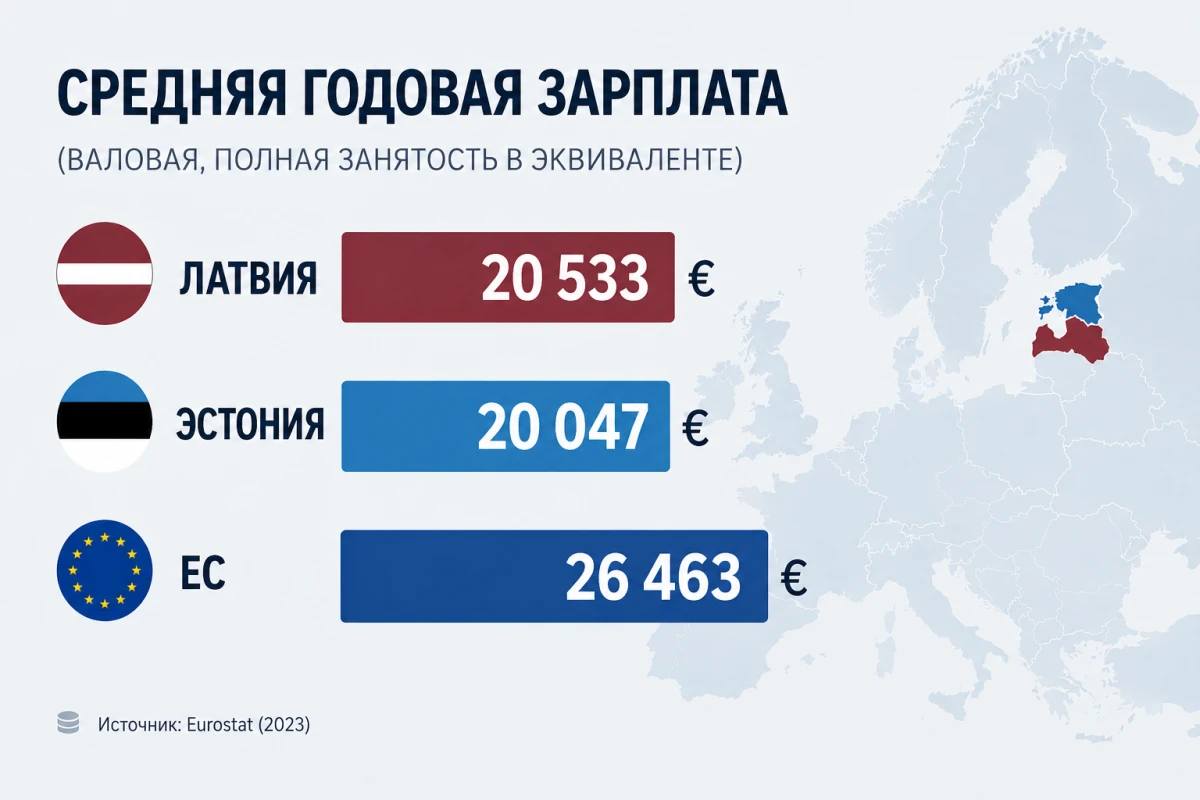
According to Eurostat data, the average net salary adjusted for purchasing power parity in Latvia in 2025 amounted to €20,533 in conditional units. In Estonia, this figure reached €20,047.
This is not about the actual salary in euros, but rather a special calculation that takes into account the price differences between countries and shows how many goods and services a person can actually buy with their income.
According to Janis Hermanis, a financial and tax consultant for the Latvian Confederation of Employers, one of the main reasons for this result was the changes in Latvia's tax system. Last year, the tax burden on workers was reduced, and the taxation process was simplified. As a result, net salaries for many residents of the country increased.
At the same time, the opposite occurred in Estonia. To finance additional defense expenditures, several taxes were raised, including income tax and value-added tax. This affected the disposable income of the population.
However, experts urge caution in drawing far-reaching conclusions from a single indicator. The purchasing power of salaries reflects only how much a person can buy with their income in everyday life. However, quality of life also depends on other factors that are not directly reflected in salary statistics.
For example, the availability of medical services, the quality of education, the level of safety, and the efficiency of government services play a significant role. That is why a higher purchasing power of salaries does not automatically mean a higher overall standard of living.
Moreover, economists note that Estonia's economy is still considered more competitive and productive, and its enterprises are, on average, more strongly integrated into international markets.
On a European scale, both countries still lag significantly behind the EU average. The average purchasing power of salaries in the EU is €26,463. Luxembourg remains the leader with a result of €40,846, while the lowest figure among EU countries is recorded in Greece — €17,509.
Nevertheless, the very fact that Latvia managed to surpass Estonia in purchasing power of the average salary has become one of the most unexpected economic outcomes of the past year and shows how much tax policy and price levels can influence the real income of the population.