
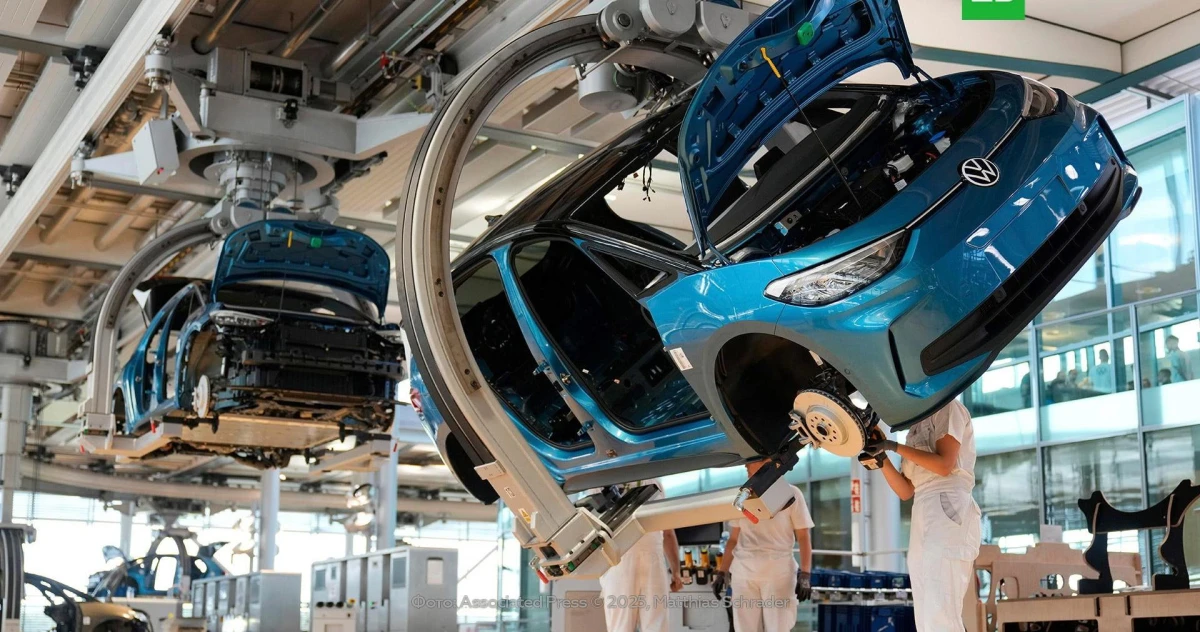
China officially demands that EU countries repeal or significantly amend the new 'Made in Europe' law.
"Chinese embassies in EU member states have conveyed China's comments and proposals to the governments of the countries where they reside," said Suo Peng, Minister of Commerce and Economy in China's mission in Brussels.
The diplomat emphasized that China does not intend to stand by and watch the process unfold. Beijing is preparing a retaliatory strike. He added that if the EU "insists on this punishment and discriminates against Chinese enterprises," Beijing will be forced to respond with countermeasures.
What the New Law Entails
The European Union aims to protect its market, and the new project presented in March is called the Industrial Accelerator Law. Its goal is to prioritize European goods in strategic sectors.
This concerns public procurement in sectors such as:
- automobile manufacturing (particularly electric vehicles);
- "green" technologies and renewable energy;
- steel and aluminum industries.
Brussels also plans to establish a strict filter for foreign money. Any investments exceeding 100 million euros will fall under special scrutiny. This applies to the production of batteries, solar panels, and the extraction of critical raw materials.
Conditions for Major Market Leaders
Beijing is particularly outraged by the rules for market leaders. If a company from one country controls more than 40% of the global market in a specific sector, the EU will issue an ultimatum.
**Such producers will be required to:
- create joint ventures exclusively with European partners;
- fully transfer their technologies to the European side;
- ensure that at least 50% of the workforce consists of EU citizens.**
Chinese Minister Suo Peng accused Brussels of "double standards." He recalled a statement from 2018, where the EU, along with the US and Japan, opposed forced technology transfers. Now, according to Beijing, Europe is doing the same.
Unity in Brussels is currently lacking, and EU member states have different views on the conflict with Beijing. France advocates for the strictest possible rules. Paris wants to protect local producers at any cost.
Germany is more cautious. Berlin calls for cooperation with "like-minded" countries, fearing to lose access to Chinese innovations and the market.
Some countries are concerned about a spike in prices. Strict rules could make production more expensive.
The conflict between the EU and China goes beyond individual measures and increasingly resembles systemic economic rivalry, writes bb.lv. The escalation of protectionism on both sides could lead to reciprocal restrictions, rising prices, and complicating access to technologies. In the near future, much will depend on whether Brussels and Beijing can move the dispute into a negotiation framework.





Leave a comment