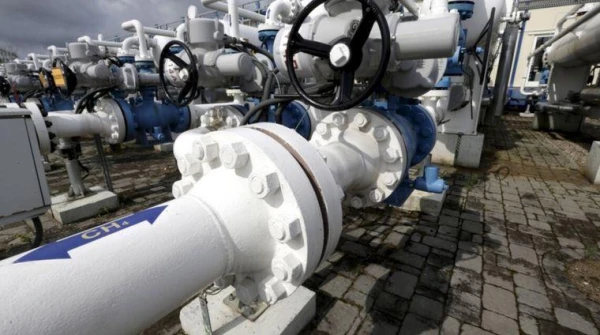
Gas prices in Europe have soared by 70%, and reserves are running low. Supply disruptions, rising inflation, and a potential tightening of ECB policy heighten fears of a repeat of the 2022 energy crisis. In just a few weeks, the conflict surrounding Iran has completely altered Europe's energy calculations.
The benchmark Dutch gas price TTF has risen from €38 to €54 per megawatt-hour since the beginning of the month - a 70% increase, and March 2026 is on track to become the month with the sharpest gas price rise in Europe since September 2021.
These figures have consequences that extend far beyond energy markets.
According to Kyos European Gas Analytics, as of March 24, underground gas storage was only 28.4% full, or 325 terawatt-hours, which is 5 percentage points lower than a year ago and significantly below the average seasonal levels of the past five years.
Germany is among the most vulnerable: its storage is only 22.3% full, nearly 7 percentage points less than a year ago.
France is in a similar position - 22.1%.
The most critical situation on the continent is in the Netherlands: there, reserves have dropped to 6.0%, or 9 TWh, which is less than a third of last year's level and significantly below the historical minimum for this time of year.
The contrast with the Iberian Peninsula could not be more striking.
Portugal enters the crisis with storage levels at 85.3%, and Spain at 55.5%. Both countries benefit from a more developed LNG infrastructure, less dependence of the electricity sector on gas, and a large-scale introduction of renewable sources, which has structurally reduced their dependence on fluctuations in wholesale gas prices.
The initial supply shock is structural, not temporary.
Qatar, the world's second-largest LNG exporter with a volume of 84 billion cubic meters per year and a key supplier for EU countries such as Italy, Belgium, and Spain, has confirmed that it can no longer meet contractual obligations following Iran's strikes earlier this month on the industrial center of Ras Laffan.
Restoring damaged facilities could take up to five years.
In an analytical note dated March 22, Goldman Sachs raised its TTF price forecast for the second quarter of 2026 from €63 to €72 per megawatt-hour, warning that European storages would have to compete for LNG cargoes with competing Asian buyers to sufficiently fill reserves by next winter.
According to the bank's estimates, in a worst-case scenario, if the reduction in energy flows through the Strait of Hormuz lasts not six but ten weeks, the average TTF price in the summer of 2026 could exceed €89 per megawatt-hour.
In a severely adverse scenario, assuming more serious long-term damage to Qatari infrastructure, TTF quotes could remain above €100 per megawatt-hour throughout the summer.
A survey of energy analysts conducted by Montel News provides even harsher estimates of these risks.
If shipping through the Strait of Hormuz is blocked for three months, the nearest TTF futures, according to forecasts from Wood Mackenzie and Montel Analytics, could spike to around €90 per megawatt-hour.
At the upper end of the range, commodity analyst Ole Hvalby from the Swedish bank SEB warns that under such a scenario, prices could fall within a corridor of €115 to €155 per megawatt-hour, as approximately 28.6 billion cubic meters of LNG would be removed from the global market.
According to surveyed experts, in the event of a six-month blockade, the average TTF price could approach €160 per megawatt-hour. This, in Hvalby's words, would be "a squeeze reminiscent of 2022 or worse" - quotes could fluctuate between €145 and €240 per megawatt-hour, and it would become "almost impossible" to inject sufficient volumes into storages by next winter.
For comparison, in August 2022, TTF quotes peaked at €345 per megawatt-hour amid Russia's invasion of Ukraine.
What This Means for Household Energy Bills
For European households, this is a real shock, but it translates differently into final energy bills.
In an exclusive interview with Euronews, Giuseppe Moles, CEO of the state company Acquirente Unico, which manages energy supply for consumers in Italy's regulated market, explained the pricing mechanism in detail.
In gas bills, the increase is almost entirely passed on to the consumer. The Italian regulator ARERA set the commodity component of the tariff for protected customers at €35.21 per megawatt-hour for February but warned that this figure does not yet reflect the price spike following the escalation of the conflict.
Electricity tariffs are also rising, as more expensive gas drives up wholesale electricity prices, but for retail consumers, this effect is more diluted.
"The electricity market has already partially accounted for the gas shock," Moles said, estimating the impact on household bills at several percentage points. "This is noticeable, but much less than the 60–70% rise in wholesale gas prices."
In the motor fuel market, pressure is spreading not only to crude oil: rising freight rates, insurance premiums, and refining restrictions are increasing the entire supply chain's costs.
"The real bottleneck is refining," Moles noted.
Italy is Already Increasing Gas Supplies from Algeria: Is It Enough?
Although the situation in Italy is better than the EU average - with gas storage levels at 43.9% - Moles warned that the immediate threat now relates more to prices than to a physical shortage of fuel.
In this context, Prime Minister Giorgia Meloni's efforts to expand cooperation with Algeria, which is already the largest gas supplier to Italy via pipeline, are understandable.
Moles called this step "a rational and important choice," noting Algeria's role in strengthening supply security.
But he cautioned against overestimating its effect. "Algeria can mitigate the impact for Italy, but it cannot single-handedly neutralize the consequences of a systemic crisis in the Persian Gulf," he said, emphasizing that disruptions in the Strait of Hormuz continue to determine global energy prices regardless of any individual bilateral deal.
"I wouldn’t expect a repeat of the 2022 scenario. Rather, we are facing a period of heightened volatility with sustained price spikes. Much will depend on the resilience of supply and the trajectory of global demand in the coming months," Moles noted.
How Could This Affect Inflation?
The period of disinflation that Europe has experienced over the past three years has come to an end - at least in the near term.
Goldman Sachs expects that in March, overall inflation in the eurozone will jump to 2.7% year-on-year - up from 1.89% in February. Almost all of the increase will come from energy, which is expected to shift from a 3.1% decrease in one month to a 5.9% year-on-year increase.
The medium-term trajectory has also changed sharply: Goldman Sachs now forecasts an average annual overall inflation rate of 2.9% in 2026, peaking at 3.2% in the second quarter - such a scenario would have been considered a "tail risk" at the beginning of the year.
Core inflation, excluding energy and food, is also expected to creep up and reach 2.5% in the third quarter as rising energy costs begin to flow into prices for services and transport.
The transmission of the shock will be uneven: Germany, as of the end of March, faced about a 25% month-on-month jump in diesel prices, while Spain partially mitigated the blow by halving VAT on most energy types.
"We expect overall inflation based on the HICP index in Germany to rise to 3.0% year-on-year in March from 2.0% in February," wrote Goldman Sachs economist Katya Vashkinskaya in a note this week.
But the direction of movement is the same everywhere.
The window during which the ECB could convincingly argue that it was on track to its inflation target of 2% has closed.
What Higher Inflation Means for Rates and Economic Growth
For the European Central Bank, the balance of power has shifted dramatically in just a few weeks.
Before the war in Iran, markets were pricing in further rate cuts until 2026. Now, that is no longer on the table.
Both Goldman Sachs and ABN AMRO expect that at the meeting on April 30 and then in June, the Governing Council will raise rates by 25 basis points, bringing the deposit rate to a peak of 2.5%.
Bundesbank President Joachim Nagel has already publicly called for a rate hike in April if pressure from energy prices does not ease.
According to prediction markets, the probability that the ECB will raise rates this year stands at 77%.
In a worst-case scenario, Goldman Sachs estimates that rates may need to rise by a total of 75–100 basis points; in a severely adverse scenario, by 150–200 basis points.
The timing for this is extremely unfavorable.
Goldman Sachs has lowered its GDP growth forecast for the eurozone for the entire year to 0.7% - nearly half the pre-conflict trajectory - as tightening financial conditions compound the demand shock from higher energy bills.
The composite PMI index for the eurozone in March was just above stagnation level, with companies' costs rising at the fastest pace in three years.
"The ECB is now in a very difficult situation," said S&P Global Chief Economist Chris Williamson, commenting on the preliminary PMI data for March 2026.
Is It As Bad As It Was in 2022?
Not yet - and perhaps it never will be, believes Bill Divaney, head of macro research at ABN AMRO.
"The scale of the current shock is unlikely to approach the energy crisis of 2022–2023 caused by Russia's invasion of Ukraine, and it will not impact the eurozone economies as uniformly as it did then," he wrote in a recent note.
This is best seen in electricity markets: although gas prices have risen by about 80% since the beginning of the year, average wholesale electricity prices in the five largest eurozone economies have hardly changed since the start of the conflict and remain about 14% below the beginning of the year.
This divergence is explained by the acceleration of renewable energy projects in Europe after 2022 and the return of the French nuclear fleet to full capacity - a structural change that now serves as a partial buffer.
The budgetary response is likely to be more restrained: governments have less room for maneuver, bond markets are less forgiving, and policymakers are much more aware than in 2022 of the inflationary risks associated with broad, untargeted energy support measures.
The 2022 crisis was a systemic shock that exposed all the vulnerabilities Europe had accumulated over decades through cheap Russian gas. The current blow is more pinpointed, more uneven, and, at least for now, more manageable.