
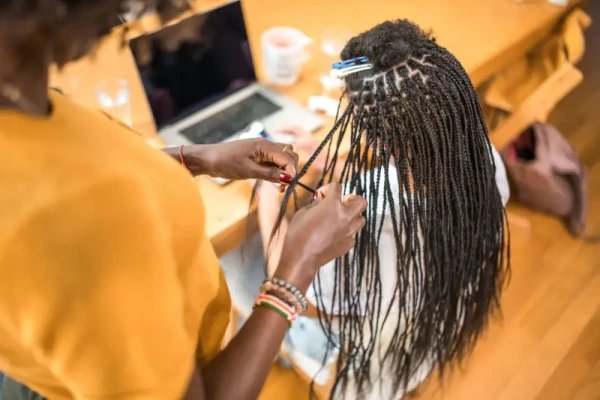
Only some manufacturers' websites offer consumers ways to check quality.
According to the results of the largest study in this field, wigs and hair extensions worn by millions of women around the world may contain chemicals linked to an increased risk of breast cancer, hormonal disruptions, and harm to reproductive health.
Scientists found nearly 50 hazardous chemicals in almost all tested samples of various products made from synthetic and natural hair, including wigs, hair for braiding, clip-in and sew-in extensions, as well as hairpieces.
These findings, published in the journal of the American Chemical Society, have prompted calls for stricter regulation of this multi-billion dollar industry and increased transparency for consumers.
"We trust companies that are not even required to exclude hazardous chemicals from their products," said Dr. Alyssia Franklin, the lead author of the study and a researcher at the American institute Silent Spring, which studies the environmental impact on breast cancer risk.
According to scientists, hair extensions are particularly dangerous because they are worn for long periods and are in constant contact with the skin.
"Hair extensions are worn very close to the body," Franklin said. "They lie on the scalp, neck, and shoulders for weeks, sometimes even months."
It is projected that by 2028, the global hair extension market will exceed 14 billion dollars.
According to the study, although many women get hair extensions for beauty or fashion reasons, a significant portion of consumers of these products are Black women, for whom this is a convenient way to manage their hair.
Synthetic hair can be purchased for as little as 20 dollars, while high-quality natural hair extensions can cost thousands of dollars.
After examining 43 samples, researchers found 170 different chemicals in them. They used a method that allows for the detection of a wide range of substances rather than focusing on any one.
Forty-eight of these are included in major international lists of hazardous chemicals, including those compiled by the UN and the European Chemicals Agency.
"There was everything from flame retardants to pesticides, as well as substances like phthalates, which are endocrine disruptors and are known to be linked to reproductive system disruption," Franklin said.
In 36 samples of hair extensions—both synthetic and natural—17 chemicals linked to breast cancer were found, and nearly 10% of the samples contained hazardous lead compounds typically used in the production of flame-retardant plastics.
Scientists say they were surprised to find lead compounds, which are not usually found in consumer goods. These substances can cause skin irritation. They are known as endocrine disruptors and interfere with hormones that regulate many processes in the body, including those responsible for development and reproductive capability.
The most commonly found chemicals in the samples included phenol—a substance used in the production of plywood and wood adhesives—and bis(2-ethylhexyl) phthalate, which is added to plastics to make them more flexible.
Researchers claim that these chemicals provoke biological changes similar to those caused by known breast carcinogens and may increase the risk of breast cancer over time.
Previous studies focused on synthetic hair, which contained hazardous metals; however, this study also tested 11 samples of natural, untouched, and mixed (human and synthetic) hair.
Untouched and natural hair is generally more expensive and marketed as hair that has never been chemically processed. Natural hair is typically not processed at all and is cut or shaved from one person.
In some cases, samples of human hair—including those labeled as untouched and natural—contained more hazardous chemicals than some synthetic counterparts, including several substances that are endocrine disruptors.
"Just because a product is labeled as made from human hair or that it is natural hair sourced from a single donor does not make it any safer than synthetic hair," Franklin said.
"There have been cases where we found one hazardous chemical in a synthetic sample, while human hair could contain anywhere from five to seven such substances," she explains.
According to researchers, these chemicals can enter the product during its manufacturing or processing, when hair undergoes various procedures to enhance its appearance, durability, or ease of use.
Franklin says that while the study did not assess the concentration levels of hazardous chemicals, some of them, such as hormonal disruptors, can be harmful even in small doses.
One of the main concerns of researchers is the lack of clear safety limits for chemicals in hair extensions set for manufacturers.
"There is no reason why hazardous chemicals should be present in products we use for cosmetic purposes. We are already exposed to many chemicals daily that are unavoidable," Franklin said.
As the study showed, there is no proven way to safely use chemically treated hair for extensions, and even measures aimed at reducing exposure are not always effective.
Pre-washing strands before application, for example, with vinegar to reduce irritation, has not proven to make wearing such strands truly safer.
In the study, only two of the 43 tested samples contained none of the hazardous chemicals identified by scientists. Both were labeled as "non-toxic" or "free from toxic substances." However, Franklin says such claims can give a false sense of security.
"These labels are not regulated by any authority, so companies can label their products without any consequences," she said.
Starting in August 2026, new, stricter regulations regarding harmful carcinogenic substances will come into effect in the UK; however, experts believe that gaps in the regulation of the hair extension market mean consumers are not receiving full protection.
Cosmetics are strictly regulated and undergo safety assessments, but hair extensions are often classified differently, so they are not tested.
Previous studies have shown that hair dyes and straightening products can increase the risk of breast cancer. However, unlike hair extensions, they are classified as cosmetics and undergo safety testing.
"Regulation only works if products are correctly classified, and compliance monitoring is conducted directly at points of import and sale," said Caroline Larissi, executive director of the industry organization UK National Hair & Beauty Federation.
"This is a really serious gap, and this study clearly shows that it needs to be addressed," she said.
In 2016, the BBC found that during the processing stage, mislabeling often occurs, and the determination of hair type often relies entirely on the honesty of sellers.
On the websites of some manufacturers, consumers are offered ways to check the quality of hair before purchasing. However, scientists believe this should not be the responsibility of consumers.
"If such products were not on the market, we would not have to choose," Franklin said. "Everyone who wears hair extensions should seriously consider the results we obtained."












Leave a comment