
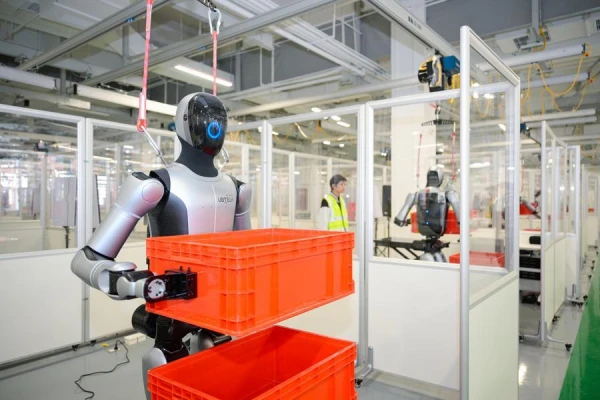
In 2025, 330 androids entered the market.
Last year marked the first year of mass production of humanoid robots in China: more than 140 domestic manufacturers presented over 330 different models. However, behind the optimism lies a harsh reality: the data deficit remains the main obstacle to the mass commercialization of such robotics.
To address this related issue, China is actively forming an extensive national network of multimodal data collection centers, which is becoming an important part of the country's strategy to transition from "robot manufacturing" to "robotic intelligence."
A striking example of such infrastructure is the multifunctional center for collecting and testing multimodal data for humanoid robots in the city of Zigong, Sichuan Province /Southwest China/. The facility, covering an area of 6,000 square meters, officially began operations on January 8 of this year and plans to reach full design capacity in March. The center is equipped with modern equipment: torque sensors in the joints of robots, high-precision RGB-D vision systems, and lidars, allowing data to be recorded with maximum accuracy at all stages of task execution.
At full capacity, the center will be able to generate 15,000 data records per day and up to 3 million high-quality records per year. The collected data is used to train robots in real industrial scenarios: sorting cargo, grasping objects, moving, and accurately placing items—basic operations for integrating robots in factories, warehouses, logistics centers, etc.
The development of data collection centers is supported at the highest state level. China has already presented its first national standards system covering the entire production chain and lifecycle of humanoid robots and embodied artificial intelligence. The regulations standardize technical specifications, evaluation criteria, and interaction protocols, eliminating fragmentation in the rapidly evolving industry.
Thanks to government support, such infrastructure projects are rapidly emerging across the country. In addition to Zigong, data collection centers for embodied AI or large training grounds for robots have been established in cities such as Beijing, Shanghai, Tianjin, Guangzhou /Guangdong Province/, Liuzhou /Guangxi Zhuang Autonomous Region/, Jiujiang /Jiangxi Province/, Wuxi /Jiangsu Province/, Wuhan /Hubei Province/, Shaoxing /Zhejiang Province/, and Zhengzhou /Henan Province/.
Among the major corporate projects in this field is the Chinese e-commerce giant JD.com, which aims to build the world's largest data collection center for embodied intelligence based on its super supply chain and real scenarios in retail, logistics, healthcare, industry, delivery, and home services. The company plans to accumulate more than 10 million hours of real video data of human activity over two years while simultaneously collecting 1 million hours of robot data. All data collection is conducted in strict accordance with the law.
The global humanoid robot industry faces a common problem—the lack of data for training robots in real conditions. As industry experts note, unlike autonomous driving, which relies on billions of kilometers of test data, operational datasets for humanoid robots in complex environments are extremely scarce. Data collection in complex industrial environments requires enormous financial and time investments. One data collection session can cost more than 1,000 yuan (approximately $145), and training a robot to sort even batteries requires tens of thousands of grasping operations.
Chinese centers employ a combined approach: remote control conducted by a human using VR devices, combined with autonomous data collection. This allows for the formation of comprehensive multimodal datasets for training AI models, accelerating algorithm optimization, and enhancing the resilience of robots to non-standard situations.
As of the end of February this year, a total of 1,138 enterprises related to robotics were registered in Sichuan Province. The launch of the Zigong center creates a solid foundation for breakthroughs in the field of "AI+" in Sichuan Province and forms successful experiences that can be utilized by other Chinese regions and foreign partners.















Leave a comment