
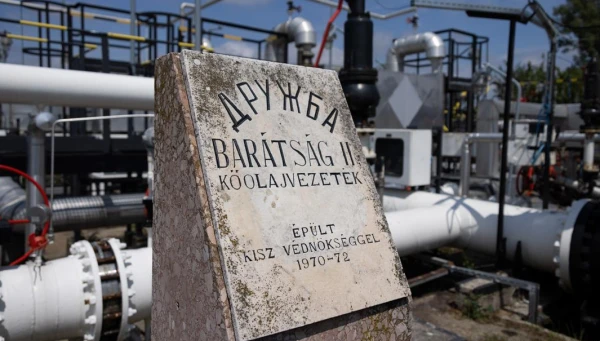
The pipeline continued to supply only Hungary and Slovakia.
Supplies of Russian oil through the damaged "Friendship" pipeline have completely ceased. Hungary and Slovakia, the last buyers of raw materials from Russia in the EU, have placed the blame on Ukraine for the fact that the operation of the pipeline has not yet been restored. Both countries currently have reserves that will last for several months. However, Hungary has already blocked the allocation of an EU loan to Ukraine and has stopped supplying diesel fuel to it, while Slovakia has threatened to cut off electricity. Forbes examined how serious the situation is for all parties involved in the conflict.
On January 27, the export of oil from Russia to Hungary and Slovakia via the "Friendship" pipeline was halted. This occurred after an accident that Ukrainian authorities linked to an attack by Russian drones. A month later, transit has still not resumed, despite the demands from Hungary and Slovakia.
Ukraine has not specified a date for the possible resumption of supplies through "Friendship," Reuters reports. In Kyiv, they state that repair work is ongoing, but they are hindered by shelling from Russia. In a note presented by Ukraine at a technical meeting of EU member states, which the agency reviewed, it was stated that as a result of Russian attacks, an oil pumping station near the city of Brody in the Lviv region, as well as technological and auxiliary equipment of the pipeline, were damaged.
The company "Ukrtransnafta," which ensures the transit of oil through Ukrainian territory, is technically ready to resume oil transportation through "Friendship." However, the company's management does not grant permission for this.
The "Friendship" pipeline, built to deliver oil from the USSR to Eastern European countries, was launched in 1964. Its length is 8,900 km, with a capacity of 1.2-1.4 million barrels per day.
The "Friendship" has two branches. Through the northern branch, oil was delivered to Poland and Germany until 2023, while the southern branch supplied Hungary, Slovakia, and the Czech Republic. The owner of the Russian section of "Friendship" is "Transneft," the Belarusian section is owned by "Gomeltransneft Druzhba," the Ukrainian section by "Ukrtransnafta," the Hungarian section by the MOL Group, the Slovak section by Transpetrol, the Czech section by Mero, and the Polish and German sections by PERN.
The EU, with its sixth package of sanctions, banned the purchase, import, and transit of oil from Russia by EU countries starting December 5, 2022, but an exception was made for oil supplied through "Friendship." In June 2023, the EU approved the 11th package of sanctions, banning the transportation of oil from Russia through the northern branch of "Friendship" to Germany and Poland, while allowing these countries to receive oil from Kazakhstan through the pipeline. Supplies through the southern branch of "Friendship" were not subject to sanctions.
The Czech Republic was able to stop using "Friendship" by April 2025. In January of last year, the modernization work on the Transalpine pipeline (TAL) was completed. It connects the Italian port of Trieste with Germany, from where up to 8 million tons of oil per year are delivered to the Czech Republic through the Mero Pipeline. This volume meets the country's fuel needs. "Friendship" continued to supply only Hungary and Slovakia, whose refineries are owned by the Hungarian MOL Group.
The EU plans to completely abandon supplies of Russian oil through the "Friendship" pipeline by the end of 2027, which Hungary and Slovakia actively oppose.






Leave a comment