Latvia, Lithuania, and Germany signed a declaration of intent to conduct a pre-project study for a joint cross-border European electricity transmission project "Baltic-German PowerLink" in the Baltic Sea, representatives of the electricity transmission system operator JSC "Augstsprieguma tīkls" (AST) told LETA.
"Baltic-German PowerLink" will connect Germany, Latvia, and Lithuania, as well as wind farms on the coast of the Baltic Sea, thereby strengthening energy supply security and energy independence, notes AST.
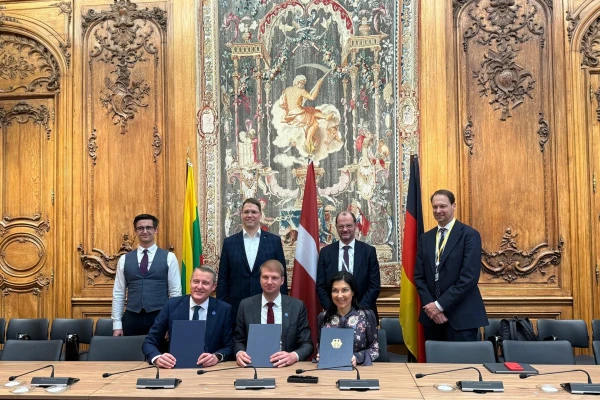
On Wednesday, February 18, during a ministerial meeting of the International Energy Agency in Paris, German Federal Minister for Economic Affairs and Energy Katharina Reiche, Latvian Minister for Climate and Energy Kaspars Melņiks, and Lithuanian Minister of Energy Žygimantas Vaičiūnas signed a declaration of intent to conduct a pre-project study for the creation of the interconnection.
The electricity transmission system operators — German "50Hertz", Latvian AST, and Lithuanian "Litgrid" — will develop a technical and economic concept for the implementation of the project by autumn, which will allow them to apply for funding from the European Union (EU) for projects of common interest.
Melņiks noted that this hybrid marine interconnection would strengthen energy security and resilience in the sector, as well as improve the investment environment, further contributing to the development of renewable energy and, in the long term, supporting economic growth.
"With this agreement, we are starting the process of research that could become the basis for advancing the project to obtain the status of a project of common interest, thereby opening up opportunities for attracting EU funding," said Melņiks, adding that the Baltic countries have already proven their ability to implement strategically important energy projects, successfully attracting EU co-financing.
AST board member Arnis Daugulis noted that the share of renewable resources in the overall energy balance is growing every year, and AST's forecasts show that within a few years, the Baltics will transition from being an electricity importer to an exporter. Therefore, it is important to timely plan the routes for exporting this energy, also considering the potential of offshore wind farms. The hybrid connection is expected to provide electricity flows in both directions, benefiting both producers and consumers in Latvia and the Baltics and strengthening energy supply security.
To form a common understanding of the technical and economic viability of the project, as well as the distribution of costs and benefits, the project has been submitted for inclusion in the European Ten-Year Network Development Plan (TYNDP). Within this framework, an in-depth analysis of the impact on EU electricity markets, supply security, and the need for EU funding may be conducted. A decision on the next steps for the project is expected by the end of 2026.
According to previous studies and initial planning conducted by "50Hertz", AST, and "Litgrid", "Baltic-German PowerLink" will be an underwater cable connection approximately 600 kilometers long between Germany and a land connection point in Latvia (southwest part) or Lithuania (northwest part). On land, an energy hub is planned to be built, through which approximately two gigawatts (GW) of power from offshore wind farms can be directed both to Germany via "Baltic-German PowerLink" and to the transmission system of the Baltic States, managed by AST and "Litgrid".
AST is an independent electricity transmission system operator in Latvia. The company is state-owned. The company's bonds are listed on the "Nasdaq Riga" debt securities list.
AST is the largest shareholder of the single operator of the natural gas transmission and storage system "Conexus Baltic Grid" — the company owns 68.46% of the shares of "Conexus".