
Currently, in the U.S., only about 25% of users regularly visit news websites after a search query.
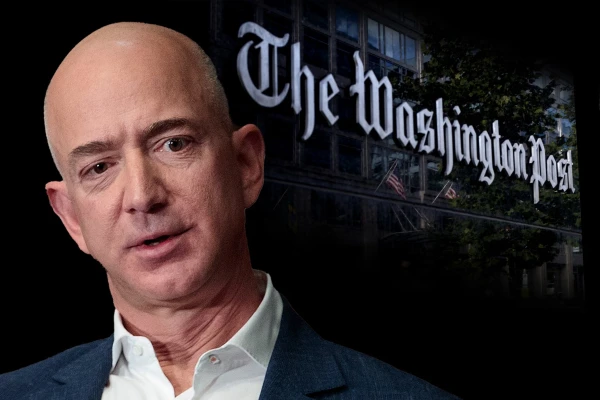
In early February, a number of jobs unexpectedly opened up at The Washington Post. Multibillionaire Jeff Bezos, one of the richest people in the world, laid off a third of the editorial staff. The sports section has been closed. The "Style" section, known for its vibrant and bold materials, no longer exists. "The Book World," one of the longest-running columns, is gone. The "Metro" section, which covered life in Washington and its suburbs (never considered a strong point of the newspaper), is already awaiting its demise. No one from the publication is even covering the Winter Olympics in Milan. The Middle East department has been completely disbanded. Following them were the staff covering the Ukrainian crisis.
These are the consequences of the staffing "massacre" orchestrated by Bezos at one of the most famous American newspapers on February 3. The usual scenario for such mass layoffs: first a general meeting, then emails to each employee. Two-thirds were told they could "stay." The rest were told they needed to resign. In an ultimatum manner.
Bezos's axe is not the first blow to the newspaper. Distress signals from The Washington Post have been coming for the last two years. Losses of $100 million in 2022 and $77 million in 2023. The newspaper has been losing staff, disillusioned and outraged after Bezos canceled the decision of his own editorial board to support Kamala Harris in the presidential race in 2024, costing the newspaper 375,000 subscribers. He sharply shifted the editorial policy in favor of the right, insisting on promoting "free market" ideas instead of the previous social-democratic and liberal ones.
Now Bezos claims that the newspaper is losing money and cannot cope with rising expenses. Meanwhile, experts from the American cable and satellite news network MSNBC believe that just half a percent of Bezos's annual income would allow the newspaper to operate for five years.
Senator from Massachusetts Elizabeth Warren emphasized that at the time of the layoffs of several hundred employees, including a correspondent covering Amazon's activities and accountability, Bezos's net worth was estimated at $250 billion. Her colleagues also noted that this decision reflects Bezos's and other billionaires' support for the Trump administration's policies.
Bezos seems to have renounced his previous intentions to promote press freedom. At least, that was the slogan he brought into The Washington Post office in 2013. Texas Congressman Greg Casar joined Warren, stating that Bezos is turning "the editorial board into a mouthpiece for billionaires." He is firing journalists from The Washington Post while spending $40 billion on the film "Melania" about the current First Lady of the United States.
The American press sees this situation at The Washington Post as a problem for the entire media industry in the country. MSNBC experts agree that regardless of their views, publications like The Washington Post and The New York Times create significant content that is then discussed worldwide. And this destruction occurs against the backdrop of billionaire Patrick Soon-Shiong shifting the Los Angeles Times to the right, while billionaire Ellison's family adapts CBS News's agenda to the MAGA ideology (the American political slogan "Make America Great Again"). Not to mention social networks, where billionaire Elon Musk is experimenting with Twitter (now X), and TikTok is in the hands of Trump allies, prompting Americans to seek alternatives.
The chair of the editor-in-chief of the newspaper was once held by Ben Bradlee, who witnessed the dawn of The Washington Post: the publication initiated the investigation into the Watergate scandal, which inspired the film "All the President's Men," leading to the impeachment of U.S. President Richard Nixon. Since then, there has been a turnover in leadership positions, and employees have been leaving the editorial office, many of them to the main competitor from New York — The New York Times.
As a result, the newspaper has noticeably "thinned out." Now a typical daily issue of the newspaper consists of 36 pages, and the weekly edition is even smaller — 24 pages. Take, for example, the issue from January 20 of this year, just before the mass layoffs. We open it and see section "A" with national and international news, as well as editorial articles and opinion columns. It occupied 18 pages of the print version. Section "B," also 18 pages, included the "Style," "Sports," and Metro columns, as well as one page each for the weather forecast and obituaries. The six-page section "C" consisted entirely of advertisements for property sales by trustees. Additionally, a weekly supplement called Local Living was published.
The Washington-Baltimore News Guild, representing journalists, and the Post Tech Guild, uniting online publication staff, stated that Bezos's team did not present "any organized plan for the restoration of the publication — only to cut, cut, and cut again." At noon on February 5, journalists held a "Save The Post" rally in front of the newspaper's office in downtown Washington "in defense of journalism and jobs." Readers were invited to participate.
"The Washington Post has long been a bastion of accountability journalism," the union stated. "Decisions that weaken its collective weaken its mission. This rally is in defense of jobs, in defense of journalism, and in defense of the public's right to know." Martin Baron, the first editor-in-chief under Bezos after his acquisition of the newspaper, who previously had a distinguished career, told the Associated Press that his former employer created "an example of almost instantaneous, self-destructive destruction of the brand."
"The future of The Washington Post is vital for readers, for democracy, and for all who believe that facts still matter. If Jeff Bezos no longer supports this mission, then The Post and its readers deserve another leader who will," the union's statement said. But, as one can easily guess, the matter did not progress beyond the statement. There is no need to look far for examples in history.
Now American society seems to be just learning to walk, finding itself in a situation where no one hides that a huge segment of the media is owned by people with immense wealth. And who have no obligation to protect the interests of readers and the so-called democratic norms that the union speaks of, if they do not want to. In the context of the rightward shift of the Trump administration, the capitalist class has discovered that suppressing political press is a great way to win the president's favor and protect their financial interests.
Trump himself publicly leads this process, as if he is in charge of the editorial office, and periodically sends signals to those who need to correct themselves by publishing a blacklist in a special section on the White House website. Notably, The Washington Post made it onto that list two months before the mass layoffs.
It is hard to imagine where more than 300 editors and reporters laid off from The Washington Post will find work when the news industry worldwide is going through its worst years.
Let’s go back a bit. In laying off its employees, The Washington Post editor Matt Murray pointed out that the reason for the impending "strategic reset" was the lack of organic search traffic. According to him, it has fallen almost by half over three years — largely due to AI services that answer user queries instead of directing them to media websites. In an emotional outburst, the American press began to attribute everything to political reasons, blaming Bezos (and rightly so), but largely did not reveal Murray's alarming words. Apparently, they are too truthful.
According to data from the international non-profit analytical company Digital Content Next, media consumption has indeed changed. In the first half of 2025, the number of user clicks on external links decreased by 25% compared to the same period in 2024. The most significant blow was felt in the segments of science, education, and healthcare — here the traffic drop reached 30%. Now users are increasingly staying within aggregators, search ecosystems with built-in AI, getting a brief answer, and not clicking through to the original source. The information chain has become shorter. And at the same time, the audience of many media outlets has shrunk.
If in 2024 the total number of visits to news websites was 2.3 billion, then in 2025 it dropped to 1.7 billion — a decrease of 26% of potential readers in a year. Another telling marker is that today 69% of user queries end without a click to the site, while a year ago it was 56%.
In response, the media has to reinvent itself. Revenue from contextual advertising, partnership integrations, and subscriptions is falling. Even a loyal reader is turning into an occasional consumer of fragmented summaries. But the decrease in the number of clicks is just part of the entire alarming picture that the media is forced to confront.
The information flow is increasingly being intercepted by chatbots. For instance, requests to ChatGPT have increased by 212%, and the annual volume of visits reached 47 billion. Google itself is also putting a spoke in the wheels of the media, trying to compete with OpenAI by offering the AI aggregator Gemini built into the browser. Because of this, people can limit themselves to an AI overview in search results, not clicking through to the sources — despite all warnings about the potential unreliability of information.
Returning to the American market. A study by the Pew Research Center illustrates this trend well: in the U.S., only about 25% of users regularly visit news websites after a search query. The rest limit themselves to information obtained directly from AI aggregators. The result is a decline in CTR (click-through rate, a metric in internet marketing) of traditional news pages.
According to Similarweb, in July 2025, traffic to 46 of the 50 largest English-language news websites significantly decreased compared to July 2024. In the top ten, all experienced a decline. The most noticeable was CNN: down 33.6% (to 471.6 million visits). In the top 50, the most serious drop was suffered by Forbes — down 51.8% (to 92.4 million). The Washington Post saw a decline of 40.8% (to 82.3 million).
The Washington Post found itself between the hammer of AI and the anvil of its billionaire owner, who the very next day after laying off a third of the newspaper's staff announced plans to direct $200 billion towards the development of artificial intelligence in 2026, aiming to become "another tech giant in the arms race in the field of AI," The Guardian summarized. However, after Amazon announced its plans, the company's stock fell nearly 9%, but that is a completely different story.














Leave a comment