
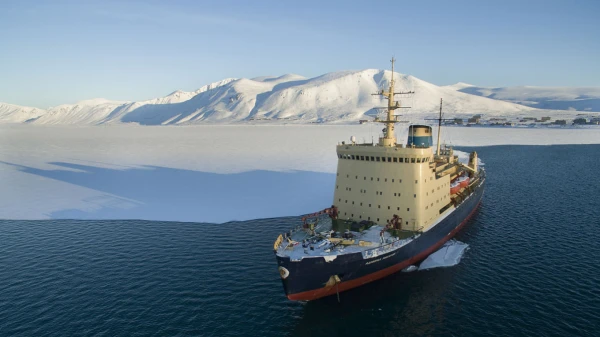
The volume of gas transportation decreased by 2.7% year-on-year in 2025.
President Vladimir Putin's plan to increase cargo transportation through the Arctic has failed for the second consecutive year. In 2025, 37.02 million tons of cargo were transported via the Northern Sea Route (NSR) — 2.3% less than the previous year. This is according to an analysis by the Gekon center, the results of which are reported by Kommersant. In 2024, 38 million tons of cargo were transported via the NSR. At that time, the figure showed an increase of 2 million tons over the year. However, according to a presidential decree signed in 2018, by 2024, transportation through the Arctic was supposed to reach 80 million tons, and by 2030 — 200 million.
Stretching 5,600 km and crossing five Arctic seas, the NSR allows for a reduction of 7–10 days in shipping time to Asia compared to the traditional route through the Suez Canal. But despite the speed of delivery, there are still few willing to send cargo through the Russian Arctic. In 2025, the bulk of the NSR cargo flow consisted of Russian exports (60%, or 22.2 million tons). The share of LNG, oil, and gas condensate in it was at 83%. Supplies came from the Yamal LNG project, NOVATEK, Arctic LNG-2, and the Novy Port field of Gazprom Neft.
At the same time, the volume of LNG transported via the NSR decreased by 2.7% year-on-year in 2025. A decline in oil shipments from the Novy Port field was also recorded. Shipments of bulk cargo fell by more than 2.5 times to 0.41 million tons, while general cargo, which includes products from Norilsk Nickel, decreased by 2.2% to 3.91 million tons.
Meanwhile, the volume of petroleum product transportation increased by 43% to 1.27 million tons, and gas condensate by 17% to 1.55 million tons. Additionally, the cargo flow of ore concentrate increased 13.5 times to 365,000 tons. This is explained by the shipment of 330,000 tons of iron ore concentrate from the Murmansk region to China. Overall, the cargo turnover of the NSR ports amounted to 32.5 million tons, of which 29.1 million tons, or over 90%, accounted for the port of Sabetta.
In 2026, the volumes of transportation via the NSR will not exceed the level of 2025, as there are still no sources of growth, says Mikhail Grigoryev, head of the Gekon consulting center. According to him, in order to fully utilize the route from the Kara Gates Strait to the Bering Strait, Russia needs to cooperate with other countries and seek new markets both in the eastern Pacific direction and in the western Atlantic.











Leave a comment