
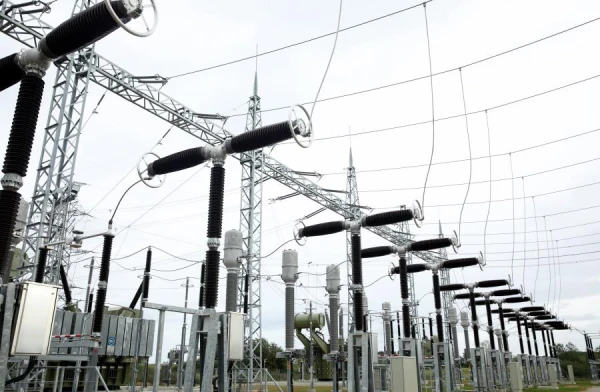
This winter has been harsher than previous ones, leading to increased concern — will there be enough fuel and how much will it cost? Similar worries also apply to electricity, writes Maris Krautmanis on nra.lv.
After Russian strikes on civilian infrastructure in major cities of Ukraine, many apartment buildings were left without heat and electricity, which is terrible — even if heating is restored, pipes freeze, and it is extremely difficult to bring the building back to order. Hundreds of thousands of people are forced to freeze.
But even without war, the cold has caused problems in Latvia — car engines won't start, and various devices on the railway infrastructure fail.
"How reliable are electricity supplies in Latvia? Could the prediction come true that at some point electricity will suddenly disappear — even for a couple of hours?" — to this question, the largest electricity producer "Latvenergo" and the main responsible for electricity supply safety enterprise JSC "Augstsprieguma tīkls" responded.
Electricity production in Latvia has even increased
"Latvenergo" produces electricity. And it produces powerfully. For example, last week, total electricity consumption in the Baltics increased by 2% to 748 GWh. The volume of electricity consumed in Latvia remained unchanged compared to the previous week — 179 GWh. In Estonia, consumption increased by 4% — to 230 GWh. In Lithuania, 339 GWh of electricity was consumed, which is 2% more than the week before.
Electricity production in the Baltic countries increased by 5%, totaling 557 GWh. In Latvia, electricity production was 1% higher compared to the previous week — 192 GWh. Meanwhile, in Estonia, production increased by 24%, amounting to 127 GWh. At the same time, in Lithuania, electricity production decreased by 1% — to 238 GWh. Last week, the volume of production compared to consumption in Latvia was 107%, in Estonia — 55%, in Lithuania — 70%. Overall, in the Baltic countries, 74% of the electricity consumed in the region was produced," said Andris Siknis, director of communications at the "Latvenergo" group, to "nra.lv".
Thus, judging by this information, electricity production is in full swing, and even if we see that the "mills" of wind farms are not spinning, the process continues in other areas of generation.
Complete shutdown of the energy system is an unlikely scenario
Gatis Jungkhans, a member of the board of JSC "Augstsprieguma tīkls", commented on the situation regarding the reliability of electricity supply to "nra.lv": "The electricity supply system of Latvia — both the electricity networks and the power plant base — is relatively well developed and provides a high level of stability. At the same time, it is important to understand that no energy system is absolutely invulnerable, and completely avoiding short-term outages is impossible. It is important to distinguish between global failures at the energy system level and local outages. As for global incidents — a complete shutdown of the energy system of Latvia or the Baltic countries — this is a scenario with an extremely low probability, and it has never occurred. Regarding local incidents — the largest distribution network operator in Latvia published statistics: in 2025, there were 11,106 damages to the electricity network; an average household in Latvia faced outages 1.5 times a year, and the average duration of power outages per customer was about two hours a year."
The number of cyberattacks is increasing, but they are being fought
"The demands on the energy system of the Baltic countries are constantly increasing. Electrification is increasing electricity consumption — in January of this year, a new historical maximum consumption of 5483 MW was recorded in the Baltic countries. The Baltic energy system is facing an increasing number of diversions to infrastructure and cyberattacks. But at the same time, the capacity and resilience of the energy system are actively increasing. In recent years, the main 330 kV network of the Baltics has been reinforced with new or completely reconstructed power lines totaling over 1000 km. Over the past five years, the installed capacity of power plants in the Baltics has increased by 80% and is expected to reach a historical maximum of 16 GW by the end of 2025. In 2025, 20 TWh of electricity was produced in the Baltics — the largest volume in the last seven years. If in 2020 the Baltic region imported 43% of the necessary electricity, then in 2025 — only 26%, and this positive trend will continue," said Gatis Jungkhans, a representative of JSC "Augstsprieguma tīkls".
Concerns about the situation
Economist Aivars Strakshas wrote on Facebook: "An anticyclone is dominating over the Baltics, morning temperatures are approaching minus 30 degrees, and if the forecasts are to be believed, the influence of the anticyclone will persist, and it won’t get significantly warmer.
Now is the time to think about how reliable electricity supplies are for the Baltics and Latvia. At such times, risks are perceived not as abstract considerations, but as a very concrete threat not only to comfort, and it is easy to imagine what would happen if electricity suddenly disappeared. Even for a couple of hours."
As an example, Aivars Strakshas used data from Nordpool for February 2 to understand what is happening in the Baltic region and in Latvia.
"By the electricity flows (data for February 2), it is clear that the Baltics will only be saved by imports. The entire region will receive 31.1 thousand MWh of electricity. On average, this means a power deficit of 1297 MW, which roughly corresponds to the entire consumption of Latvia. The Swedes and Poles will earn well because the average daily price in the Baltics will be 317 euros/MWh, which is about 3 times more expensive than in Sweden and 2.5 times more expensive than in Poland. For the Finns, it is just slightly cheaper than ours. But who cares about the price," wrote Aivars Strakshas on February 1.
Let’s not forget where we live
"The main problem of energy security in the Baltic region is Lithuania, which, despite having almost 2.5 GW of installed wind farm capacity, is completely dependent on imports, as the wind strength is negligible. Even if the capacity of wind farms were doubled, it wouldn’t help much. There is a deficit in Estonia as well, but it is not as dramatic. Latvia is currently fully self-sufficient in electricity, although the CHPs are operating at nearly maximum capacity, and, as usual in winter, there is little water. We have already checked the reliability of the electric cables on the bottom of the Baltic Sea.
So, the story with wind farms is not about the reliability of electricity supply. It is also unreasonable in the Baltic region to rely solely on heat pumps for heating private homes. Electricity may disappear precisely when it is needed the most.
We also had "green" initiatives to limit and even ban wood heating.
In my life, I remember air temperatures of minus 42 degrees. I cannot imagine how much electricity consumption would rise in such a case, and it is quite certain that then wind farms would turn into energy consumers. Hydropower plants also wouldn’t provide much, if they provide anything at all. When discussing the reliability of electricity supply, one should not forget what geographical place we live in and not rely too much on global warming, but rather consider historical temperatures," said the economist.









Leave a comment