
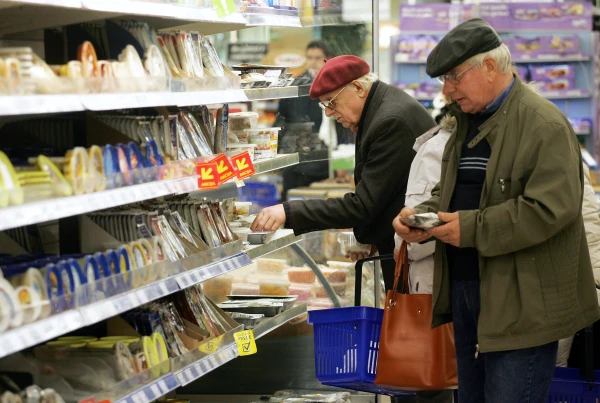
Whether a Latvian is an infant or of advanced age, healthy or sick, food is consumed. And so, the Ministry of Economics has become concerned about "persistently high prices for food products on store shelves."
Public discussions on the Action Plan to Support the Trade Sector are ongoing until January 22. The bb.lv portal has closely examined the food plan of the Latvian government.
Eating Up Every Third Euro
According to the assessment by Viktor Valainis (Union of Greens and Farmers), based on data from the Central Statistical Bureau, our people are spending more money on food, but in fact, they are purchasing fewer products. All this "may indicate a decrease in demand and a fall in the purchasing power of the population." In the group of low-income residents, about 30% is spent on food.
According to Eurostat, "the level of food prices in Latvia is currently one of the highest in the European Union." Thus, our stores sold food products at prices higher than those in Old World countries with much higher incomes – Belgium, Germany, Italy, Spain, and the Netherlands.
Compared to neighboring republics, Lithuania and Estonia, our consumers spend 20% more on purchasing food products. This has occurred, experts indicate, "under the influence of economic, geopolitical events, and other factors."
Choose Latvian Products
The Ministry of Economics has outlined four main areas for trade reform, which will be implemented by February 27, 2027:
- Revising regulatory requirements for cash registers and the threshold for annual audits and inventories;
- Simplifying the placement of trade advertisements in public places;
- Updating street trading regulations;
- Assisting rural retail and micro-enterprises, more than half of which currently operate at a loss.
"The Minister of Economics, as stated in the Plan, has prioritized ensuring that essential food products are accessible to the public at an acceptable price according to the purchasing power of the population of Latvia, using locally produced food as an important tool to achieve this goal."
Golden words – but there are certain nuances that V. Valainis, as an experienced politician, should keep in mind. If we do not take into account intangible assets such as patriotic, image, and reputational motivations for buying Latvian products, then the only competitive advantage of our products is the low transportation and logistics component. That is, local products do not need to be transported from afar, kept in customs warehouses, etc.
Secrets of Low Prices
However, paradoxically, even with cheap logistics for local products, a package of buckwheat from Kazakhstan turns out to be about 40% cheaper than Latvian counterparts. This is because the minimum wage level there, converted from tenge, is 160-170 euros. Considering the vast market and grain production there, it can be assumed that the costs for production, which include fuel, equipment depreciation, etc., are lower.
Ukrainian producers would be in a similar position, where the minimum wage is currently about 195 euros before taxes; however, ongoing combat actions, power supply disruptions, and labor shortages due to mobilization make it a less reliable supplier.
Therefore, as our shoppers may have noticed, a number of popular products from Ukraine occasionally disappear from the shelves of stores in Latvia.
Remembering the Local Store
Meanwhile, we here in Riga have evidently become spoiled. The notion of supermarket dominance with a familiar assortment is far from reality. 88% of grocery stores in Latvia are still small enterprises with fewer than 10 employees, located in small towns or rural areas. Unfortunately, their absolute number is steadily declining – on average by 3-4 percent per year.
And it cannot be said that the disappearance of local shops in the "neighborhood" format is due to large chains. For example, only 3 supermarkets from a relatively recently opened German chain with loud advertising campaigns are located in Latgale. For housewives in the regional center of Balvi, the nearest such store is in Rēzekne, i.e., 80 km away.
But the local shopkeepers in Latgale are still somewhat active – there are 89 independent stores in the region, while in Zemgale, there are only 51.
Taxes Not Earned
Overall, there are still 354 points in the republic that meet the NACE classification criteria for "Non-specialized retail trade, mainly of food, beverages, or tobacco." Their annual turnover, however, is substantial – over 80 million euros. But one in four small shops, according to data from last fall, was a tax debtor – averaging 4,400 euros.
The new version of the Law on the Circulation of Alcoholic Beverages, effective from August 1, 2025, which prohibits the sale of alcohol before 10 AM and after 8 PM, as well as on Sundays after 6 PM, has hit these minority businesses hard. "The overall turnover in small shops in the regions is decreasing every day," the Ministry of Economics is concerned.
And these shops are "very important for residents and sometimes even perform a social function"...
The New – Well-Forgotten Old
To all those who like to recall on social media the shameful shortages we lived through during the previous regime, your author would like to quote the title of a development by the Ministry of Economics of Latvia – "Organization of Street Trading – an Effective Solution for the Modern Urban Environment."
An ideal bureaucratic initiative… for 1986, let’s say, when the future Minister Valainis was born. He might also be recommended such fresh forms of trade as selling cabbage from dump trucks or organizing food orders at the workplace. All this would be funny if it weren’t so sad – more than two decades after joining the European Union, our Ministry of Economics suggests "focusing on locally grown agricultural products, as well as wild berries, mushrooms, flowers, etc."
Before the past winter holidays, your author also bought instead of a Christmas tree – from a grandmother in front of the former supermarket "Minsk" – a lovely composition of conifer branches in a kind of nano-pot. I think it will last until Easter, at least. And then, perhaps, there will be a "development of a standard application for obtaining a permit for street trading."




Leave a comment