
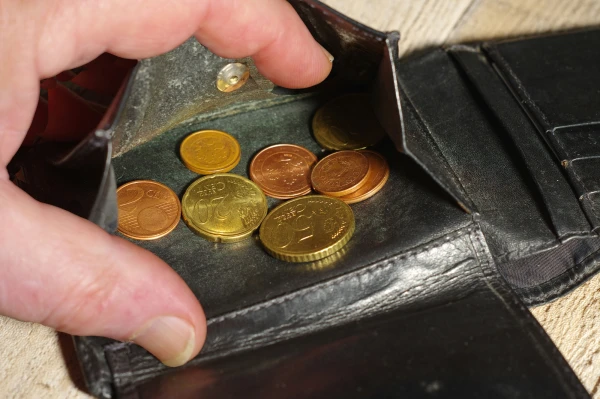
Latvia remains the last of the Baltic countries that has not begun to phase out one and two cent coins. Both Estonians and Lithuanians are gradually withdrawing them from circulation, rounding the total purchase amount and no longer giving small change. Estonians are now sending their small coins to Latvia. And in our central bank, they believe that the time has come to abandon such a low denomination of change, reports TV3 News.
Is it time to follow the example of neighboring countries and start phasing out one and two cent coins, which either sit in our piggy banks or, in many cases, simply disappear without a trace? This is what the Bank of Latvia is calling for.
Several eurozone countries, including Lithuania and Estonia, have decided to gradually eliminate one and two cent coins from circulation. There are several reasons: high production and processing costs — in fact, minting a one cent coin costs more than its nominal value. Additionally, transporting them back and forth harms the environment, and their low purchasing power makes them inconvenient for actual transactions.
The solution chosen by neighboring countries is to round the total purchase amount. Each individual item costs what it costs, but the total purchase amount will always end in five or zero. For example, a total of 10.92 euros will be rounded down to 10.90 euros, while 10.93 euros will be rounded up to 10.95 euros. This only applies to cash transactions, and, accordingly, small change is no longer given. When paying by card, everything remains the same.
Latvia also benefits from the decision of its neighbors. Estonians send their withdrawn coins to Latvia, which buys them back at face value. This agreement is beneficial for both parties: we do not need to order new coins, and the Estonians do not have to recycle theirs. The Bank of Latvia is convinced that we should also start phasing out this small change.
"80% of one cent coins and 70% of two cent coins enter circulation only once before disappearing — they are thrown away somewhere. Essentially, every year, several hundred thousand residents of Latvia are just throwing money on the ground. In my opinion, we are not rich enough to afford this," said the President of the Bank of Latvia, Mārtiņš Kazāks.
The Bank of Latvia recommends following the example of neighboring countries to reduce such losses. Surveys show that about half of the residents of Latvia support the abandonment of one and two cent coins.
Where this small change ultimately ends up is not exactly known. Of course, some of it does physically fall to the ground — intentionally or accidentally left on the streets, in parks, and other places. There is also a portion that remains with the people themselves. There are many possibilities. One of them is a conditionally positive option: our piggy banks.
It is positive because, most likely, in the end, this money will be used and return to circulation when the piggy bank is broken. But there is also a portion that hides in the pockets of old pants and jackets, in drawers, behind furniture, under car seats. Overall, there are quite a few of these coins, and this is perhaps understandable. If we have, say, eight cents in one cent coins in a drawer, we are unlikely to throw them away, but we also probably won't put them in our wallets to go to the store. So it all accumulates. Many of us have it this way, and in the end, the total amount becomes quite significant.
However, the Latvian Association of Traders urges not to rush into rounding the purchase amount, as they believe it will create various inconveniences.
"Traders will face additional problems, having to reprogram calculations in their databases. Plus, in a regular store, a product could be bought at one price, while in an online store, there will be a different price — there everything will be exact, without rounding, and payment will have to be exactly what is indicated. Therefore, in my opinion, this creates certain inconveniences," believes the President of the Latvian Association of Traders, Henriks Danusevičs.
The Budget Commission, overseen by the "New Unity" party, is responsible for this area in the Saeima. The leader of the parliamentary faction of this political force stated that this issue was discussed with the President of the Bank of Latvia. The idea is supported, but most likely not at this moment.
"I would say that we will have to come to this step. Estonia and Lithuania are doing this now, and I think we will have to do it too. But we need to look at their example — whether everything is fine there and whether this contributes to inflation. What the President of the Bank of Latvia says, and I agree with, is that such a decision could be implemented together with the so-called cash register reform," believes the chairman of the "New Unity" faction in the Saeima, Edmunds Jurevics.
The issue of one and two cent coins is a topic for the near future, but certainly not for next year. Accordingly, this decision will have to be made by the next Saeima.












Leave a comment