
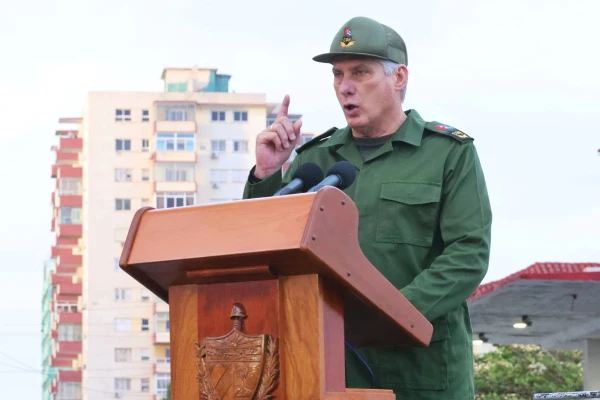
The Kremlin is absolutely indifferent to what will happen on the distant island.
"Cuba will be next, and its days are numbered," Senator Lindsey Graham confidently states again on Fox News. The Republican representing South Carolina is called a "hawk," and his ominous statements about the future foreign policy goals of President Donald Trump occasionally align with reality. In the same interview on the main Republican channel, Graham called Trump the "gold standard" of a president — even better than Ronald Reagan.
Trump wants to surpass Reagan, as well as Jimmy Carter and Richard Nixon, echoing Graham, the Atlantic magazine, which is not known for its affection for the sitting president, reports. One of the authors of the article, Vivian Salama, claims that members of the Trump administration and his trusted aides revealed to her the Napoleonic plan of the White House chief. The essence of the plan is to "overthrow three autocracies at once." The third is to be Cuba.
Energy Genocide
As a result of the operation in Venezuela, the U.S. not only overthrew its president but also effectively took control of the country's oil, stating that one of its main consumers — Cuba — would no longer receive it. Caracas supplied the island with estimates ranging from 10,000 to 20,000 barrels daily. Another comparable source of oil for Cuba was Mexico; however, Washington threatened large tariffs on any countries that would supply Havana with "black gold." After some time, an energy crisis began in Cuba.
Currently, there are no refueling stations at the country's airfields — and planes do not fly, cities have no electricity — industry has stopped, and the working hours of shops, banks, and even hospitals have been reduced. Transportation is not operating. As CNN reports, life on the island has effectively come to a halt. Trump demanded that the Cuban authorities sign a "deal" — but what this deal should entail is not disclosed.
Trump jokingly approved the idea of making U.S. Secretary of State Marco Rubio the president of Cuba on his social media. Less than an hour later, Trump addressed the Cuban authorities with a demand to "make a deal" with the White House. Before the operation in Venezuela, there were also reports of negotiations between Washington and Caracas regarding Maduro's resignation, for which he allegedly put forward conditions that did not satisfy the White House.
In Cuba, Trump's hints were met negatively. President Miguel Díaz-Canel wrote on X (formerly Twitter) that the island is ready to defend itself "to the last drop of blood." The Ministry of Foreign Affairs of the Republic called the rhetoric of the White House similar to Washington's policy, reported Cuban Radio Rebelde.
It then became known that Mexico had suspended oil supplies to Cuba. Its president, Claudia Sheinbaum, publicly linked this to general fluctuations in energy resource supplies and stated that there was no pressure from the U.S.
Two days later, Trump declared a state of emergency in the U.S. due to a declared threat to national security and foreign policy from Cuba. The White House statement noted that Havana allegedly supports terrorism and collaborates "with many hostile countries" — Russia, China, Iran, and the groups Hamas and Hezbollah.
In this regard, Trump also announced the introduction of additional protective tariffs on goods from countries that sell or supply oil to Cuba. An international state of emergency was declared on the island, and Washington's actions were labeled as "energy genocide." Cuban Foreign Minister Bruno Rodríguez Parrilla stated that the U.S. is creating extreme living conditions for Cubans, accused the Trump administration of lying about Havana, and called the United States itself the only threat to peace, security, and stability in the region.
It is worth noting that Cuba has been under American sanctions since 1960. In mid-February, Mexico sent humanitarian aid to the island, and last week — another 1,200 tons of food, but there was no mention of energy resources.
Then, the head of the Cuban Foreign Ministry, Rodríguez Parrilla, arrived in Moscow, where he first met with Lavrov and then with Russian President Vladimir Putin, who called the sanctions against Cuba unacceptable.
"We have always stood by Cuba in its struggle for independence, for the right to determine its own path of development, and we have always supported the Cuban people," the Russian president said.
But what real assistance Moscow can provide Havana is currently difficult to say. Political science lecturer at Drexel University Sergey Kostyaev, in a conversation with RTVI.US, suggested that the Kremlin is absolutely indifferent to what will happen in Cuba. However, as they say, there is another point of view: political changes on the island will cost Moscow a historical ally in the Caribbean, located just 90 miles (145 km) from the U.S., noted Daniel Pedreira, a visiting lecturer at the Department of Politics and International Relations at Florida International University.
On the day Rodríguez Parrilla arrived in Moscow, Axios reported that Secretary of State Rubio is conducting "secret" negotiations with Raúl Guillermo Rodríguez Castro — the grandson of Raúl Castro, Fidel Castro's younger brother and leader of the Cuban revolution. The comandante transferred the reins of power on the island to Raúl in 2006, who was officially succeeded in 2021 by the current president, Díaz-Canel. However, according to Axios sources, Rubio did not speak with him.
The Wall Street Journal reported, citing sources, that the Trump administration wants to change the power in Cuba by the end of 2026. To this end, it is allegedly looking for agents within the country willing to help. At meetings with Cuban emigrants and community groups in Miami and Washington, White House representatives focused on finding someone within the current Cuban government "who understands where this is all going and wants to make a deal."
Rubio, who has Cuban roots (he was born in Florida to immigrant parents), is often called the architect of the Trump administration's Latin American policy and one of the organizers of Maduro's kidnapping. It is worth noting that during that operation, American troops eliminated 32 guards — Cuban citizens. They were buried with honors in their homeland.
"In Trump's team, there is Rubio, who, as I understand, is an advocate for regime change in this country. Therefore, ideally, for Trump, there would be a change of the Castro regime and a return to the fold of American trade and American influence. It is unlikely that Cuba will agree to Trump's demands without some direct military intervention; this does not seem realistic," Kostyaev noted in a conversation with RTVI.US.
It is worth noting that in an interview with Bloomberg, Rubio stated that the Cuban government needs to implement economic reforms and give the people economic freedom. According to him, the leadership of the republic lacks a fundamental understanding of what business and industry look like, which is why investments from Europe are failing, "and as a result, people suffer."
"Forget for a moment that there is no freedom of speech in Cuba, no democracy, no respect for human rights. The fundamental problem of Cuba is the absence of an economy, and the people who govern this country, control it, do not know how to improve the daily lives of their people without relinquishing power over the sectors they control. They want to control everything," Rubio said in the interview.
The American side perceives the 41-year-old Castro nicknamed "Crab" (due to a deformed finger) and his entourage as young, business-friendly Cubans rejecting the revolutionary legacy and seeking rapprochement with the U.S., Axios continues. However, a source in the Trump administration notes that Rubio's dialogue with "Crab" is more of a discussion about the future than negotiations. The decision regarding Cuba rests with Trump.
"President Trump has a wide range of options regarding the Cuban regime. Some measures are more military in nature, while others are diplomatic or economic. It seems that his administration is using diplomatic and economic tools as a first step, as evidenced by news of negotiations with the Cuban regime. The Trump administration aims for a change in the Cuban regime," Pedreira told RTVI.US.
Pedreira suggested that U.S. regional policy will be based on the operation in Venezuela. Axios also compares the negotiations — or discussions — between Rubio and Castro with the situation in Caracas: the U.S. is engaging in dialogue with the remaining Maduro team in Venezuela, particularly with Vice President Delcy Rodríguez, who is currently acting as head of state. "They are looking for the next Delcy in Cuba," the Axios source said.
Trump himself initially refused to directly answer the question of whether an operation in Cuba similar to Venezuela's is planned, but noted that it would not be difficult to implement. Just last week, he publicly allowed for a "friendly takeover" of the island. According to him, Cuba has no money, oil, or food, so the country allegedly wants help from the U.S.
Trump stated back in early February that his administration was in contact with "people at the very top" of Cuba. However, a number of media outlets later reported that there had been no substantive negotiations.
After Trump declared a state of emergency and threatened tariffs on countries supplying oil to Cuba, Díaz-Canel accused the "clique that exploited the interests of the American people for their own purposes" of fascism and genocide.
"Trump seeks to strangle the Cuban economy by imposing tariffs on countries that trade oil with Cuba in the exercise of their sovereignty," he also wrote on X (formerly Twitter).
However, after that, in early February, he stated that Cuba is ready for dialogue with the United States on any topic — but without pressure or preconditions, and without interference in the internal affairs of the republic.
"Given the numerous simultaneous crises in Cuba (economic, energy, healthcare, infrastructure, transportation, etc.), Havana is in a position where negotiations with Washington are more likely than in the past," Pedreira noted in a conversation with RTVI.US.
In February, American Republicans of Cuban descent in Congress urged Trump to charge Raúl Castro with the downing of two planes in 1996, which were carrying members of an American humanitarian organization. The presidential administration has not yet responded.
Then there was an incident that even Rubio called "extremely unusual." A boat under American flags approached the shores of Cuba from Florida with ten armed men, who began shooting at the island's coast guard vessel. In return fire, four of them were killed, including at least one American citizen, while the rest were Cubans residing in the U.S. The survivors were hospitalized and arrested; a local resident who planned to meet them was also detained. Rubio stated that the U.S. had nothing to do with the incident.






Leave a comment