
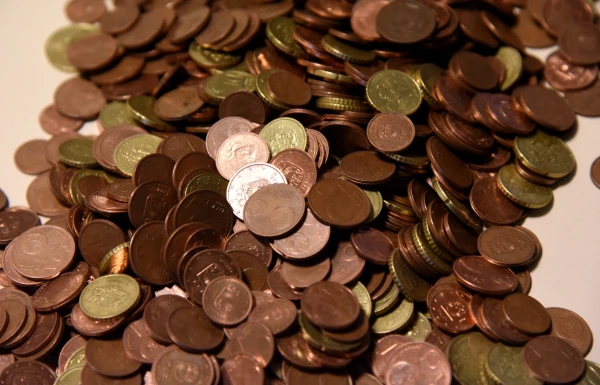
The 1 and 2 cent coins, which began to be withdrawn from circulation in Estonia at the beginning of 2025, are being sent to Latvia as part of a mutually beneficial agreement, reports the Estonian portal ERR.
Estonia has ceased the issuance of new 1 and 2 cent coins since the beginning of the year due to the introduction of new rounding rules for cash transactions. Besides Estonia, Finland, the Netherlands, Ireland, Belgium, Italy, and Slovakia have also stopped giving change in 1 and 2 cent coins.
The Bank of Estonia reported that the small coins being withdrawn from circulation are sent to Latvia, which exchanges them at face value. This deal is beneficial for both parties: disposing of the coins would be significantly more expensive, and for Latvia, it is also cheaper to receive coins from Estonia and exchange them at face value than to order new ones. Over the course of the year, approximately 10 million euros worth of small coins have been withdrawn from circulation in Estonia, and the first batches have already been sent to Latvia.
Retail businesses are also pleased with the changes, as they have simplified giving change and reduced the number of cashier errors.
Although there has been ongoing discussion in Europe for several years about completely abolishing 1 and 2 cent coins, it faces opposition from Greece, Austria, and Portugal, where large coin minting enterprises generate significant income.
The Bank of Estonia noted that although the five-cent coin remains in circulation, the abandonment of it may not be far off, as the purchasing power of such small coins is effectively being nullified due to inflation.
Additionally, there is discussion about the possibility of replacing 5 euro banknotes with coins, as banknotes of that denomination wear out within a year.
1 and 2 cent coins are still accepted as a means of payment but are not used when giving change. When paying with coins, a retail business is not obligated to accept more than 50 coins for a single purchase.














Leave a comment