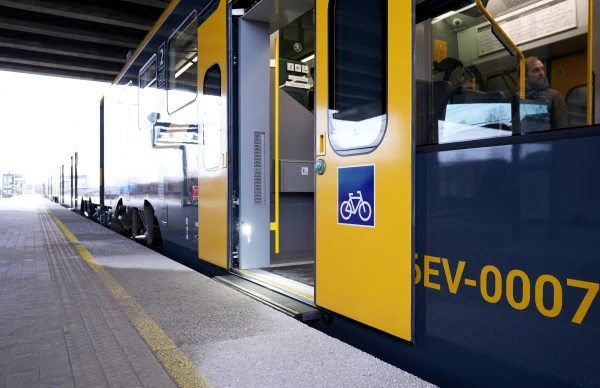
The Czech public transport manufacturer "Škoda Group" is currently confident that the delivery of nine battery electric trains (BEMU) for Latvia will occur on time, said Petr Novotny, the CEO of "Škoda Group," in an interview with the LETA agency.
He explained that earlier the supply of new electric trains from "Škoda" to Latvia was affected by the war in Ukraine and disruptions in supply chains, which were completely destroyed and unusable.
"However, over time, new routes and new working methods were created. It was only a matter of time — how to respond to external circumstances. Of course, today we do not know what will happen in the future, but we have established a very reliable way to deliver our products," noted Novotny.
He pointed out that last year, "Škoda Group" signed a contract to supply 25 trains to the Bulgarian railway company, and within 14 months, the first train was delivered.
Therefore, he expressed confidence that the processes have stabilized, and "Škoda Group" can operate according to the schedule that was agreed upon.
At the same time, Novotny assured that under extreme weather conditions — both at low and high temperatures — the operation of batteries is guaranteed for a distance of at least 100 kilometers.
In turn, the project director of "Škoda Group" Pavel Beranek added that the company conducted calculations for the most critical conditions — for a fully loaded train at a temperature of minus 40 degrees, when the battery is already at the end of its life cycle.
"We have confirmed that the batteries are so reliable that they will ensure the operation of trains in any conditions," he emphasized.
Novotny noted that battery trains are currently the main product of "Škoda Group."
"We believe that these trains have a future of 15–25 years, as they allow for movement in areas where there is no electrified infrastructure, as well as introducing more environmentally friendly energy into transport, allowing for the abandonment of diesel engines in trains," emphasized Novotny.
The head of "Škoda Group" also indicated that alternative solutions, such as using hydrogen in train engines, are currently not economically viable enough to support mobility.
At the same time, he said, there is room for hybrid solutions, for example, in the portfolio of "Škoda Group" there are battery trains with diesel engine support. According to him, this is a product that expands the operational range of battery trains to more than 100 kilometers without electrified infrastructure, allowing access to remote areas.
He pointed out that this is how "Škoda Group" is currently shaping its product portfolio, and there is interest from customers in the Czech Republic, Poland, and the Balkan countries.
"For Central Europe, such solutions are definitely necessary, as not all railway lines are electrified. For example, in the Czech Republic, only 30% of all railway lines are electrified," he noted.
As previously reported, on December 11, the Road Transport Directorate signed a contract with the Czech consortium of companies "Škoda Transportation – Škoda Vagonka" ("Škoda") for the purchase of nine battery electric trains (BEMU) worth 89.409 million euros.
The delivery of battery trains is scheduled by 2029. The trains will be purchased using funds from the European Union Cohesion Fund and the state budget of Latvia. The contract also provides for the possibility of acquiring an additional seven trains if appropriate funding is available.
It is planned that the new battery trains will operate in the direction of Daugavpils and Cesis, where the necessary charging infrastructure will be built for them. With the purchase of additional trains, it will be possible to replace a large part of the diesel trains and service routes such as Rezekne and Valmiera.
It was previously reported that in mid-December 2023, "Pasažieru vilciens" began passenger transportation on 32 electric trains produced by the Czech company "Škoda Vagonka." Before that, the trains were tested for a long time on the railway infrastructure of Latvia. Despite this, in December 2023 and January 2024, the new trains regularly encountered various malfunctions.