
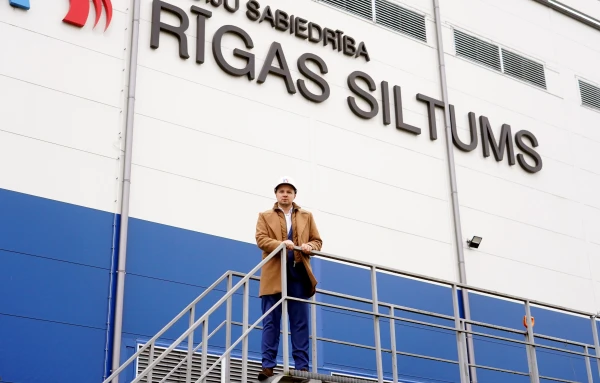
The goal of JSC 'Rīgas siltums' is to increase the share of buildings in Riga connected to centralized heating to more than 90% by 2035, stated the chairman of the company Kalvis Kalniņš in an interview with the LETA agency.
"In general, centralized heating is available to about 72–76% of buildings in Riga, but our task is to expand the network so that this figure exceeds 90%," noted Kalniņš, adding that this could be achieved approximately by 2035.
He indicated that the medium-term strategy of 'Rīgas siltums' includes annual investments of at least 25–30 million euros for the reconstruction and expansion of heating networks.
Kalniņš also noted that 'Rīgas siltums' is considering new directions beyond Riga. Cooperation has been established with the municipalities of the Kekava and Marupe regions, and this year a project for apartment buildings in the Ropazi region has been completed, where a fourth-generation heating system has been built, providing sustainable and more efficient heating with lower heat losses.
"This project has outlined further development directions. Therefore, we are considering prospects in Ropazi, the already mentioned Kekava and Marupe regions, as well as all nearby available areas in the suburbs of Riga. Of course, the most important aspect is the technical and economic assessment and justification. If anyone is interested in connecting to the centralized heating network outside Riga, we are happy to consult and are ready to consider the possibility of cooperation," Kalniņš explained.
He noted that, for example, towards Riga Airport there used to be only fields, but now both commercial and residential development is actively progressing. The company ensured the possibility of laying heating networks in such places before construction began, to avoid a situation where a house is built first and engineering communications are connected later. However, this also comes with certain risks, as the construction of heating pipelines requires significant investments, and everything must be economically justified.
According to Kalniņš, the past financial year, which for 'Rīgas siltums' runs from October 1 to September 30, ended positively and with stable results, despite the fact that the past winter was one of the warmest in the last decade.
He reported that in the heating season 2024/2025, the average air temperature was 4.7 degrees, while in the 2023/2024 season it was 2.6 degrees. As a result, in the last heating season, the company supplied consumers with 2.7 million megawatt-hours (MWh) of thermal energy, which is 4.2% less than the previous year.
"Our revenues are tied to the volume of heat produced, but we successfully coped with the challenges of a warm winter – the results are stable and in line with our plans, and the preliminary profit will be within budget," said Kalniņš.
To achieve this, the company carried out a number of activities: the structure and management of personnel were optimized, resource management efficiency was improved, and the market model was adjusted – last year, a pilot project for daily thermal energy purchases began for the first time, and a review and prioritization of investment projects was conducted.
When asked about forecasts for this heating season and financial year, Kalniņš replied that there are many external factors that could affect the situation. "We cannot influence either the weather conditions or the fluctuations in energy resource prices in the market, which significantly affect both our tariffs and the cost of production. Considering the trends of the last three years, we do not see winters becoming particularly colder – rather the opposite, they are becoming slightly longer and warmer," he explained.
At the same time, Kalniņš emphasized that the enterprise will seek a balance between uncontrollable and manageable factors to provide the highest quality heating service for clients.
He also acknowledged that warm winters create additional challenges, so the company is working to connect more clients to the network.
"This is one of the priority areas of our activity. Every year, new clients with a total thermal capacity of 20–23 megawatts (MW) connect to the centralized heating system of 'Rīgas siltums' in Riga. This is equivalent to an average-sized Latvian city that we connect to centralized heating in Riga and its surroundings every year. Work is also underway to improve internal efficiency, which helps mitigate the negative impact of external factors," noted Kalniņš.
He added that the company monitors climate changes, weather conditions, and takes into account that insulating houses will reduce final thermal energy consumption.
"Therefore, the only effective solution is to expand the client base. If we can ensure this, thermal energy consumption will remain stable by 2030," Kalniņš noted, adding that the number of clients disconnecting from the centralized heating system in Riga is 15–20 times less than the number of new connections.
The chairman of the board of 'Rīgas siltums' reported that in October the company had more than 8,300 clients connected to the centralized heating system.










Leave a comment