The talks between Donald Trump and Xi Jinping in Beijing ended without announcements of major breakthroughs in trade or geopolitics. However, both sides tried to show the world that even amid conflicts over Taiwan, Iran, and the global economy, the US and China are ready to maintain dialogue.
US President Donald Trump completed his visit to Beijing and left China without specific announcements about large-scale agreements that had previously been announced by the American side.
Despite this, the summit with Chinese President Xi Jinping is seen as an attempt to temporarily stabilize relations between the two largest economies in the world after several years of sharp escalation.
Over the course of two days, the leaders discussed a wide range of topics — from Taiwan and trade to the war around Iran and global security.
"We solved a lot of different problems that other people couldn’t solve, and our relationship is very strong," Trump said after the talks, without specifying details.
Although the parties hardly announced any specific results, the tone of the negotiations was noticeably softer than during previous crises between Washington and Beijing.
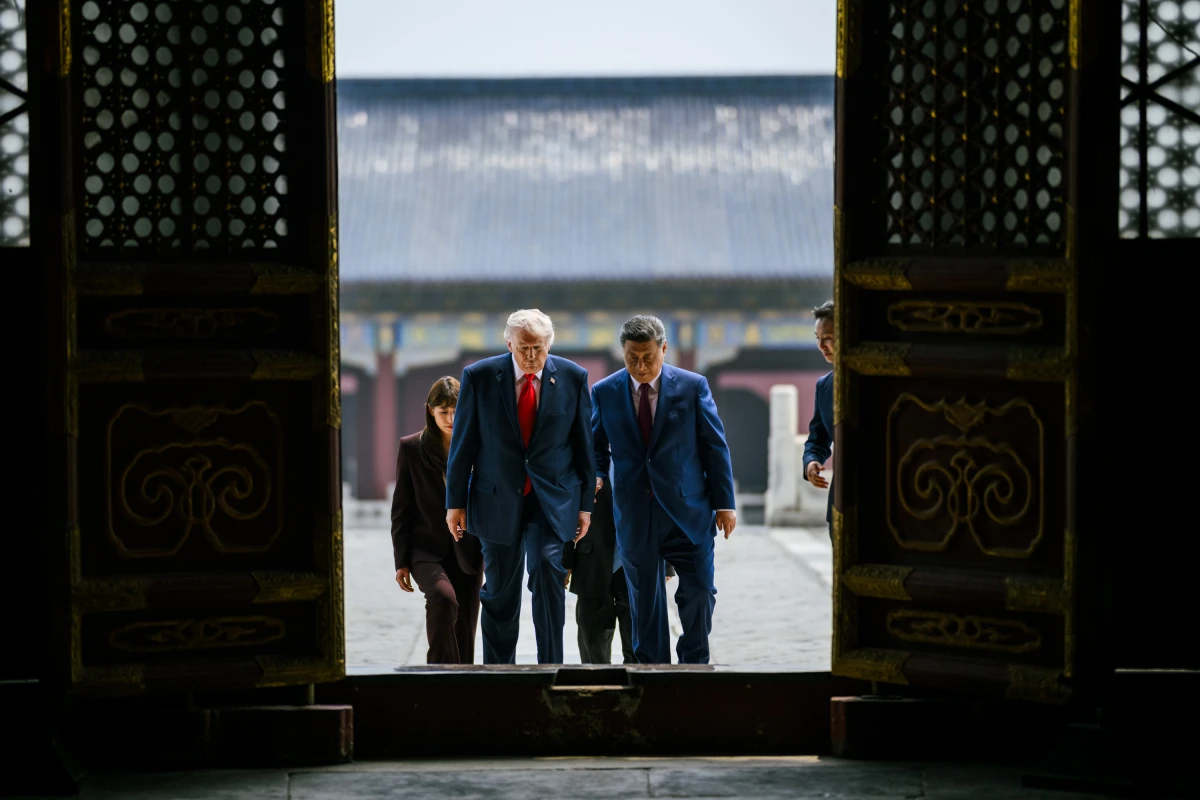
This was particularly evident in the public part of the visit. China organized a very ceremonial reception for Trump: a military band, an honor guard, schoolchildren with flags, and a walk through the closed gardens of Zhongnanhai — the residence of the leadership of the Communist Party of China, which allows very few foreign leaders.
Trump clearly appreciated such a reception.
"We were treated very well," noted the American president.
During the visit, he repeatedly spoke warmly of Xi Jinping.
"He doesn’t like unnecessary talk. No games, no discussions about the weather or stars. He is completely focused on the business, and I like that," Trump said.
One of the main topics of the negotiations was the war around Iran.
Washington hoped to understand whether China was willing to use its influence on Tehran to de-escalate the conflict. China remains the largest buyer of Iranian oil and an important diplomatic partner of Iran; however, after the summit, there were no signs of a serious change in Beijing's position.
Trump stated that Xi promised not to supply military equipment to Iran and offered assistance in resolving the conflict. However, US Secretary of State Marco Rubio later reported that Washington did not ask China for mediation at all.
In official statements, the parties only confirmed the need to prevent Iran from acquiring nuclear weapons and to keep the Strait of Hormuz open — one of the key routes for global oil trade.
The topic of Taiwan remained no less tense.
Xi Jinping once again called it "the most important issue in Sino-American relations" and warned that the wrong approach could lead to conflict.
"Otherwise, countries will face conflicts and confrontations," the Chinese leader stated.
Beijing continues to consider Taiwan part of China and does not rule out the use of force for "reunification." Meanwhile, the US maintains military and political support for Taipei, although the Trump administration has indicated that it does not intend to sharply change the previous American policy on this issue.
In the economy, Trump tried to present the visit as a success.
The American side stated that China could increase purchases of US agricultural products and acquire 200 Boeing airplanes. However, Beijing has not yet confirmed most of the deals announced by Washington.
In official Chinese reports, there was only talk of the need to expand cooperation in trade, tourism, healthcare, and agriculture.
Experts note that the absence of large specific agreements shows that the fundamental contradictions between the countries have not disappeared. However, after several years of trade wars, sanctions, and rising military tensions, even a temporary reduction in the degree of conflict is considered an important result by many.
The summit in Beijing did not bring loud breakthroughs, but it showed that the US and China are not yet ready to completely abandon dialogue even amid global rivalry.