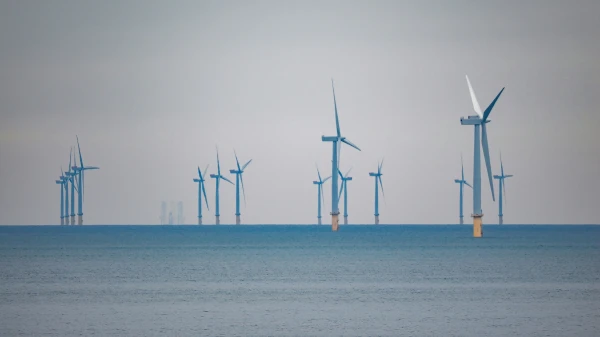
The planning of an offshore wind farm 60 kilometers from Saaremaa has slowed down due to an unexpected discovery that alarmed developers: a communication cable connecting the Russian cities of Kingisepp and Kaliningrad was found on the seabed, reports Postimees.
Offshore wind farm projects are a politically sensitive topic. A year ago, disputes over energy, particularly regarding offshore wind farms, became the last straw that led to the collapse of the ruling coalition of the Reform Party, the Social Democratic Party, and Eesti 200. As a result, a support program worth 2.6 billion euros was shelved.
Although it seemed that the issue of new offshore wind turbines had been removed from the agenda, developers actively continued to implement plans that had gained momentum in previous years. For example, in May 2025, Saare Wind Energy received the first-ever construction permit in Estonia for the construction of an offshore wind farm 11 kilometers off the western coast of Saaremaa. Other successful auctions were held in the vicinity of the island.
The most relevant area in the context of this story is located about 60 kilometers west of Saaremaa. The first auction for the Saare 1 site, conducted by the Consumer Protection and Technical Regulatory Authority (TTJA), failed, and the second was won by the sole participant – the French company Oxan Energy in collaboration with Ocean Connect Energy and SNOW. From the Estonian side, the project named Avara is led by project manager Nikon Vidyaev and Karlis Goldstein. Both are former officials of the Ministry of Climate who left public service in 2025 amid a major dispute over wind farms.
Initially, the project area was 88 square kilometers, and by 2033, the company planned to install up to 60 wind turbines with a total capacity of 900 megawatts. Now, project participants are aware that they will have to contend with significant restrictions. The reason is the Kingisepp – Kaliningrad communication cable running through this area, which the developer was unaware of when applying for the construction permit.
Cables on the seabed, especially in territorial waters, are not uncommon. The consortium developing the wind farm also confirmed to Postimees that the need to consider the presence of cables is standard practice in the offshore wind energy sector. Moreover, the media has mentioned the existence of underwater infrastructure in the Baltic Sea connecting Kaliningrad and mainland Russia. Therefore, the fact that this came as a surprise to all project participants may seem surprising. In conversations with Postimees journalists, developers expressed the sentiment that the organizing authority TTJA could have notified them about this in advance.
Regardless, the risk of a reduction in area is real. How much it will need to be reduced remains to be seen. Project leaders already met with representatives from the Ministry of Climate and the Transport Department in December. At the meeting, it was confirmed that anchoring is prohibited in the cable protection zone, which is 0.5 nautical miles wide, and construction above it will be impossible in the future.
According to developers' calculations, approximately 49 square kilometers, or 55.5 percent of the planned area, will become unusable due to this.
However, the state sees no reason for hasty conclusions that half of the construction area will have to be abandoned. According to Liina Roozimeä, head of the construction and industry bureau at TTJA, it is possible to cross the protection zone, for example, with service cables from the wind farm. "The Maritime Safety Act only prohibits damage to the marine cable. Construction work must be carried out with due caution, and the issue of crossing cables must be resolved in such a way as to avoid damaging any of them. Technical solutions for this are widely available on the market today. The developer has not presented evidence to assert that 55.5 percent of the area will become unusable," she told Postimees.
She added: "TTJA believes that it is too early to assess the scale of restrictions until the planned activities are clarified, additional evidence is gathered, and other environmental studies or technical expertise are conducted."
In correspondence with government agencies, developers acknowledge that they will likely have to shift the park's territory. However, this does not diminish their ambitions regarding the number of wind turbines. Nevertheless, the presence of the cable has raised concerns for the developer in a broader sense.